I've been mostly re-reading Ngaoi Marshes, including library ones, but I also found the missing books from the Sookie Stackhouse series last time I was at said book temple so I got them. Including the first one, much to my pleasure, because it always does seem a little off to not read the first one in a series doesn't it. So now I've read Dead In The Family, Dead and Gone, Dead Until Dark, Dead As A Doornail. In one of them, well, Sookie meets vampires 'coz Bill comes to town, in one there's the fairy wars and she's tortured (pretty gruesomely), then one is the follow-up to that and she's with Eric and... well, to be honest all I remember off-hand is that she first doesn't get a kick out of sex the way she used to because, hey, torture but then she does and all is well and there's a load of sex, but there was most likely some sort of plot too. In one of them her telepath five-year-old little relation comes to stay together with her fairy cousin, and in one her sister-in-law gets crucified, in one the were-wolves come out of the closet, in one Tara's vampire boyfriend gambles her off to a vampire psycho, and in one Eric's maker comes with the Tsvarevitch of Russia.
Oh, they all run together. I remember first one best, because it is the best. The longer the books run the more unbelievable the Sookieverse becomes. The supernatural beings are so unable to be discreet that no-one can credit that they were ever hidden. I appreciate the plot changes made in the tv show - they most often were for the better. Tara is an incredibly lame and uninteresting character in the books, whereas Tara on the tellybox is pretty fabulous.
Still get a kick out of them. But nonetheless I shall prolly be sticking to my re-reads for a while, mostly because I don't have the computer access to blog mostly. This post was brought to you by four interruptions. FOUR. (One was admittedly my own, I had to bitch about something.)
Showing posts with label Ngaio Marsh. Show all posts
Showing posts with label Ngaio Marsh. Show all posts
Sunday, September 16, 2012


Friday, August 31, 2012
Pithy quotes
I'm re-reading all my Ngaio Marshes, and the library's too (except the earliest ones that are a little crap). And in A Surfeit of Lampfreys I read the following:
I done gone reflected then that this is perhaps the point of Majgull Axelsson's Moderspassion, that we read for the book club. But I still don't think it came across very well in that book.
Maternal anxiety, he thought, was the emotion that human beings most consistently misrepresent, degrading its passion into tenderness, its agony with pathos.
I done gone reflected then that this is perhaps the point of Majgull Axelsson's Moderspassion, that we read for the book club. But I still don't think it came across very well in that book.
Sunday, February 27, 2011
Agatha Christieand Dorothy Sayers x 2, also Ngaio Marsh and Joseph Smith Fletcher x 1, respectively
What I'm actually reading now, to sound like a tv chef, is Alice Munro (for my book discussion club). It's just that my recent setback at work left me not only very down (although I'm better now) but also with a strong hankering for detective fiction, my old love. More specifically for the vintage, Golden Age type of detective fiction that don't over-analyse things and revel in upholding the status quo. Escapism, in other words. I only kept away from Tolkien (the ultimate escapism) because it, frankly, makes me cry, and from The Left Hand of Darkness because I felt I was being too pathetic re-reading that again so soon (at least, it feels as though I re-read it very recently). So detective fiction it was.
Tuesday, August 24, 2010
Ngaio Marsh: Scales of Justice and Hand in Glove
Let’s go on with two entries that have been (empty) on my draft list since 25 of June this year. I bought a stack of Ngaio books, as you may recall, and of course read them a long time ago. I’ve been putting off blogging about this because I wanted to have the covers in the post too, and I’d scanned them at work (norty norty), and I had to e-mail them to myself, and then remember that I’d done so … clearly this sank on my list of priorities.
Friday, July 09, 2010
Ngaoi Marsh: Off With His Head
This is the one I wanted to write about for midsummer, seeing as how it was about Morris dancing and all. Morris dancing is apparently not a vaguely silly, quaint dance, but an ancient ritual with a lot of deeper meaning. In this case, the dance (our Dame writes in the foreword that she's freely mashed together a few different ones in the name of fiction) shows the ritual death of the Fool, who then is resurrected. I forget the word for this, but you know - it keeps the world going for another year, that type of thing?
This dance takes place in the middle of winter in a small village that has stuck to the old ways in this respect, and that has succeeded in keeping out the tourists and others who might gawk at their customs instead of participating. Sword Wednesday is a big deal, and the primary part of the fool has been performed by the old smith Andersen for many years. His five sons too dance, and even this is part of the ritual. This time as usual they mime beheading the fool, but when it is time for him to be resurrected he lies there dead, his head away from his body. Who has beheaded him under the eyes of all the spectators at the dance?
And the cover? Well friends, it is not a folkloristic, pagan fool we see, no siree. This one wins the awful cover competition hands down and head off, all categories, all prizes. If you weren't afraid of clowns before, you will be now.
This dance takes place in the middle of winter in a small village that has stuck to the old ways in this respect, and that has succeeded in keeping out the tourists and others who might gawk at their customs instead of participating. Sword Wednesday is a big deal, and the primary part of the fool has been performed by the old smith Andersen for many years. His five sons too dance, and even this is part of the ritual. This time as usual they mime beheading the fool, but when it is time for him to be resurrected he lies there dead, his head away from his body. Who has beheaded him under the eyes of all the spectators at the dance?
And the cover? Well friends, it is not a folkloristic, pagan fool we see, no siree. This one wins the awful cover competition hands down and head off, all categories, all prizes. If you weren't afraid of clowns before, you will be now.
Tuesday, June 08, 2010
Ngaoi Marsh: Death at the Bar

There is a bookmark in this book, well, a business card from my pilates teacher, and on it I've scribbled "p 100 12 o'clock?" which is a reminder to myself to mention this when writing. However, page 100 in Death at the Bar mentions nothing about clocks, so I remembered that actually the reminder belonged to Overture to Death. I think. I haven't got the book here at work (from whence I'm furtively blogging) so I can't check. The note was to remind me of a mistake - Alleyn and Fox get to their inn after a hard night's work, at the crack of dawn, and mention that it's 12 o'clock. Something like that. So there you are. Pulp fiction fault I suppose.
Now, pulp indeed, feast your eyes on the cover
Sorry for the spoiler, but hey. This annoys me a little, I have to admit. Even though it strenghtens my theory that they had a certain selection of people who posed for these covers and there was no young handsome man among those.
The story is that three men, an extraordinarily gorgeous actor (Parish), his cousin, a brilliant lawyer (Watchman), and their friend who is an earnest and talented painter (Cubitt) (no prizes for guessing who is the best man among them) have a tradition of holidaying in a small fishing village in Devon, a village with the curious and isolating feature of being virtually hidden behind a stretch of cliffs and only accessible through a tunnel through the mountain (unless you approach by sea, of course). This time when they arrive they find a new-comer, a slightly odd man who is a wizard at darts and who has rapidly risen to the position of secretary and treasurer in the local Communist party. Watchman starts behaving strangely towards this man and appears to wish to provoke him. After a drinking session he challenges the newcomer to throw darts between his fingers - a party trick that the newcomer has demonstrated earlier. This time he misses, and Watchman receives a minor injury (minor, not crucifixion as the cover implies). Within minutes he is dead - was the dart poisoned?
There are a few twists here which make it rather fun, but the most interesting aspects of this book are class and gender. Class - in the background is the Communist party, staunchly defended and supported by the pub-owner's son, whereas the pub-owner himself is a roaring Tory. A local young woman has been given a university education and is now trapped between her background and what she has become. To her the Communist party promises egality, but it's clear that she thinks only in matter of class, really. When Watchman sexually assaults her she dismisses it as "nothing, nothing she couldn't handle". In a sad echo of one of the Soviet Union's big equality failures and hypocrisy wins she isn't aware of any feminist theories on patriarchal power, instead pretty much takes the blame herself.
Also, I wonder if the distinction between public and private bars exists anymore in the UK? Would be interesting to see.
Monday, June 07, 2010
Two covers to make you quake

Scanners FTW. Here are the covers for Death and the Dancing Footman and Vintage Murder. For the former, one has to ask oneself how long the poor model was forced to sit in that position before the photograph was deemed perfect. "Just a little longer Gerry, we're almost done. No, you shouldn't have had that extra pork pie for your lunch, I agree, and definitely not the two pints. But that's not my fault now, is it? Alright everyone, take two minutes so Gerry can loosen his belt a little. Trudy, could you dab on some extra blood there on the back of his head? Thanks love. Careful, don't step on the pipe!"
And isn't Vintage Murder just too spectacularly tacky? Blood splattered on the snowy white table cloth, I ask you. It looks more like the head waiter has been bludgeoned to death by a disgruntled diner than anything else.
And then someone brought in a three-year-old who had just had a jam sandwich and let him wipe his fingers on the dead man's shirt.

Saturday, June 05, 2010
Ngaoi Marsh: Overture to Death
Oh, dramatic isn't it? And I've just been taught how to scan something on the printer and get a jpeg file, so for your viewing pleasure:


Isn't it fantastic? Who is the woman posing? Was it a full-time or a part-time job? Inquisitive minds are dying to know. There is no information inside the book incidentally, none at all. This is functional art at its ... well, not best. Most lurid? I must get the other ones scanned too.
First published in 1939, it's set in a small village where the small society group in residence - the squire, his son, the squire's spinster cousin, the rector and his daughter (in love with the young squire-to-be), the doctor, the enigmatic single newcomer (also the doctor's lover) and the first, original parish spinster - decide to set up a play to raise funds for charity. The two spinsters are best friends and bitterest rivals, both constantly struggling to be the most important and most valuable lady-in-charge in the community, and both hopelessly in love with the handsome rector. Miss Idris Campanula is used to being the boss of everything, bullying herself onto committees and into first position always. When Miss Eleanor Prentice came to live with her cousin she used her gentler ways of manipulation to coax her way into the local petty positions of power, usurping Idris. With gossip and religious hypocrisy as the glue of their friendship they nevertheless get along by default. Miss Prentice is all set to play the music score for the play. When her finger is injured Miss Campanula jumps at the job, only to have her gloating self shot on premiere night (see illustration) by the booby-trapped piano. So, enter Alleyn and Fox. Also, bloody Nigel (sigh). Whodunnit?
Actually, it's obvious whodunnit almost from the beginning. I still enjoyed it though. There are some great Alleyn quotes in it, which I can't be bothered to look for at the moment. Ah well. It's interesting as an attempt at psychology, which must have been all the rage at the time because there are numerous references to this suspect "science". The crime is resolved after a show-down of the classic kind, with all the involved gathered back at the stage. Now, she cops out here Marsh does, because she resorts to this lame solution and tries to cover it up by having Alleyn very annoyed at having to use it - yet he does, so whatever. Also interesting is a general air of the times, a break between Victorian morality (the spinsters) and young, carefree (but not premarital) love.
Actually, it's obvious whodunnit almost from the beginning. I still enjoyed it though. There are some great Alleyn quotes in it, which I can't be bothered to look for at the moment. Ah well. It's interesting as an attempt at psychology, which must have been all the rage at the time because there are numerous references to this suspect "science". The crime is resolved after a show-down of the classic kind, with all the involved gathered back at the stage. Now, she cops out here Marsh does, because she resorts to this lame solution and tries to cover it up by having Alleyn very annoyed at having to use it - yet he does, so whatever. Also interesting is a general air of the times, a break between Victorian morality (the spinsters) and young, carefree (but not premarital) love.
Wednesday, June 02, 2010
Ngaoi Marsh: Vintage Murder
Just see that title - postmodern isn't it?
Vintage Murder was first published in 1937, and is set in the days of Alleyn's courtship of (with?) Troy. He is on holiday in New Zealand, getting away from it all. The whole book is basically a sort of colonial's defence of the real motherland, and also a bit of a tourist brochure to be honest.
Alleyn shares a night train with a group of travelling actors heading for the fictional town of Middleton. Two suspicious things happen on the journey: a theft and an assault on one of the managers of the stage company. The two incidents are seen as disturbing and odd, but are kept quiet. After their Middleton show, however, when the troupe and some guests are all gathered on the stage for a birthday celebration for the leading lady, murder is done. With a vintage bottle of bubbly, no less.
I enjoyed the book but it's not one of my favourites. The solution was hard to get to on your own unless you studied the plans of the theatre building, helpfully enclosed, of course.
Definite what-the-hell moment for the description of the Maori doctor, Rangi Te Pokiha. You see, he's civilized, just like us, but when he gets angry the savage comes out! Not so modern that. But I seem to perceive that the word savage, when applied to a person who was of native descent, wasn't as harsh as we'd percieve it today. I must look in some old dictionaries.
Vintage Murder was first published in 1937, and is set in the days of Alleyn's courtship of (with?) Troy. He is on holiday in New Zealand, getting away from it all. The whole book is basically a sort of colonial's defence of the real motherland, and also a bit of a tourist brochure to be honest.
Alleyn shares a night train with a group of travelling actors heading for the fictional town of Middleton. Two suspicious things happen on the journey: a theft and an assault on one of the managers of the stage company. The two incidents are seen as disturbing and odd, but are kept quiet. After their Middleton show, however, when the troupe and some guests are all gathered on the stage for a birthday celebration for the leading lady, murder is done. With a vintage bottle of bubbly, no less.
I enjoyed the book but it's not one of my favourites. The solution was hard to get to on your own unless you studied the plans of the theatre building, helpfully enclosed, of course.
Definite what-the-hell moment for the description of the Maori doctor, Rangi Te Pokiha. You see, he's civilized, just like us, but when he gets angry the savage comes out! Not so modern that. But I seem to perceive that the word savage, when applied to a person who was of native descent, wasn't as harsh as we'd percieve it today. I must look in some old dictionaries.
Tuesday, June 01, 2010
Ngaoi Marsh: Death and the Dancing Footman
It feels very trivial to be writing a blog entry on a vintage crime novel when the Middle East is in such turmoil. I keep checking the news, hoping that information will start to flow soon, that reason will start to prevail and most importantly that everyone accepts their own responsability for what they themselves have done. My opinion is that it's horrendous for a nation to board ships in international waters - unless there's a very good cause indeed, in which case the information should be out there for all to see. Yet it's even more depressing to contemplate even the possibility that there might have been activists preparing for violence. I sincerely hope that this mission wasn't deliberately sabotaged in that way. There were a lot of people involved who wanted it to be a mission of trust, and whose reasons for going were as much about defying Hamas as defying the Israeli blockade, I'm sure of that. What a minefield it all is.
Shall we lose ourselves in the world of house-parties and gentlemen detectives instead? But with a little nod towards war, nonetheless. Death and the Dancing Footman is from 1942, so WW2 hovers over the proceedings. The real shortages hadn't started when she wrote it, that's clear, as Jonathan Royal prepares a weekend party for a motley group of guests, all invited precisely because there is tremendous enmity between them. There seems to be no lack of great food and booze for mr Royal. His friend and confidante is a playwright named Mandrake. Being the only one with no ties to any of the other guests he is told about Royal's plans for the weekend. Royal wishes to be creative, but having no painting, musical or other skills he has decided for the unconventional medium of people. By forcing together people who dislike each other he hopes for drama and for the resolution of conflicts and lovers' tiffs. Obviously, someone gets murdered.
I was rather pleased with myself for spotting the murderer quite soon, and based on clues in the book too. It really was obvious, only one person could have done it.
I'd like to take a picture of the covers of a few of these Marshes I bought. They really are spectacularly odd - a set of the murder has been arranged and photographed, including pools of unrealistic blood. I wonder who these people were who posed for these covers? Actors of the lower grades? Artists' models? Friends of the publisher, doing it for a laugh? Was there a special guild? Special agencies? Could one trace one of the models now and ask? So many questions.
Shall we lose ourselves in the world of house-parties and gentlemen detectives instead? But with a little nod towards war, nonetheless. Death and the Dancing Footman is from 1942, so WW2 hovers over the proceedings. The real shortages hadn't started when she wrote it, that's clear, as Jonathan Royal prepares a weekend party for a motley group of guests, all invited precisely because there is tremendous enmity between them. There seems to be no lack of great food and booze for mr Royal. His friend and confidante is a playwright named Mandrake. Being the only one with no ties to any of the other guests he is told about Royal's plans for the weekend. Royal wishes to be creative, but having no painting, musical or other skills he has decided for the unconventional medium of people. By forcing together people who dislike each other he hopes for drama and for the resolution of conflicts and lovers' tiffs. Obviously, someone gets murdered.
I was rather pleased with myself for spotting the murderer quite soon, and based on clues in the book too. It really was obvious, only one person could have done it.
I'd like to take a picture of the covers of a few of these Marshes I bought. They really are spectacularly odd - a set of the murder has been arranged and photographed, including pools of unrealistic blood. I wonder who these people were who posed for these covers? Actors of the lower grades? Artists' models? Friends of the publisher, doing it for a laugh? Was there a special guild? Special agencies? Could one trace one of the models now and ask? So many questions.
Sunday, November 08, 2009
Ngaoi Marsh: The Nursing Home Murder
This novel comes from the Diamond Anniversary Collection from HarperCollins, which means the novels come in sets of threes. I'd already read the first two, A Man Lay Dead and Enter A Murderer, which naturally meant that I was a little annoyed at having to lug around all those extra pages. (Especially since I actually own the first two.) Makes the book harder to hold with one hand, don't you know. On the upside though, the volume includes a great introduction by Ngaio Marsh herself on Roderick Alleyn (pronounced ALLEN thanks be to God for clearing that up for me!), and her first published short story (not crime). Very interesting! Ngaoi writes that when she created Alleyn she wanted to create an ordinary man, not one of these affected detectives that abound(ed) in crime fiction, the ones that are defined by their mannerisms and habits - but she admits that she failed a bit, at least at first. She ironed out those rough edges later. On the whole these Diamond editions seem like they might be worth collecting really, at least if they all contain freebies.
Oh, and unrelated but not, look at this blog, devoted solely to New Zealand crime fiction!
When I read The Nursing Home Murder I was first struck by how bad it was. I mean, considering. I was quite taken aback. The writing feels much more stilted and has less flow then the Marsh I'm used to. There were some odd things, like references, like footnotes, to the two earlier books - has this been added by teh publisher for this edition or was it like that all along? It's lame. And it has a theme that is very current for a book from 1935, namely forced sterilization and the "weeding out" of people with "undesirable genetic traits". Ring a bell? But at first this is mentioned as a matter of course, and I'm going oh sweet mother of God, Ngaio babe, are you PRO? But it sort of resolves towards the end. I mean, I'd be able to put this book in the contra faction. I don't remember the other two (which are from just before and just after this one) as being THAT poor, but possibly I was just starved for Marsh at the time.
The story is that a minister, responsible for a controversial new Bill (on sterilization, probably, but I don't think it's actually said outright), ignores a stomach ache and ends up in emergency surgery. He dies on the operating table, and the widow is convinced it was murder. Turns out that, actually, everyone present might have done it. Carrying on a theme from the previous two books we have the Communists lurking about in a revolutionary rage, and Nigel the journo as Alleyn's sidekick. Oh how glad I am that he was axed. Poor book, but readable if you're loyal and interested.
Oh, and unrelated but not, look at this blog, devoted solely to New Zealand crime fiction!
When I read The Nursing Home Murder I was first struck by how bad it was. I mean, considering. I was quite taken aback. The writing feels much more stilted and has less flow then the Marsh I'm used to. There were some odd things, like references, like footnotes, to the two earlier books - has this been added by teh publisher for this edition or was it like that all along? It's lame. And it has a theme that is very current for a book from 1935, namely forced sterilization and the "weeding out" of people with "undesirable genetic traits". Ring a bell? But at first this is mentioned as a matter of course, and I'm going oh sweet mother of God, Ngaio babe, are you PRO? But it sort of resolves towards the end. I mean, I'd be able to put this book in the contra faction. I don't remember the other two (which are from just before and just after this one) as being THAT poor, but possibly I was just starved for Marsh at the time.
The story is that a minister, responsible for a controversial new Bill (on sterilization, probably, but I don't think it's actually said outright), ignores a stomach ache and ends up in emergency surgery. He dies on the operating table, and the widow is convinced it was murder. Turns out that, actually, everyone present might have done it. Carrying on a theme from the previous two books we have the Communists lurking about in a revolutionary rage, and Nigel the journo as Alleyn's sidekick. Oh how glad I am that he was axed. Poor book, but readable if you're loyal and interested.
Sunday, November 01, 2009
Ngaoi Marsh: Tied Up In Tinsel
Fed up with "real literature" I have decided to wallow in crime fiction for a while. Specifically as much vintage as I can get my hands on - I may even re-read some. I was pleased to find a Ngaoi Marsh at the library that I hadn't read, although to be honest I think I must have - the story seems a little familiar. But there were huge chunks that were not, so maybe I haven't? Haven't blogged about it anyway. Although the book is old (written in -72, reprinted -76 by Aeonian Press, a company that seems to have taken pride in a hit-and-miss approach to inking their typewhatsits, the little metal letters like, that you print with. The print is sometimes very blurry) so I should in all fairness have seen it when I had my MASSIVE detective story craze a few years ago, before I started the blog. Although I did just find a new Marsh, a collection of three novels (two of which I've read I might add, typical), so maybe someone has donated some books or something. Not important. Moving on.
Being a late Marsh it has moved with the times - somewhat. We have here a murder in a country house, with a limited number of suspects. But, since this is the seventies, the country house is a delapidated new accquisition by an excentric rich man, who has made his fortune in antiques, and who staffs it cheaply with criminals - murderers - from the nearby prison. Troy is here painting his portrait, and when Alleyn unexpectedly is home for Christmas he arrives just in time for the murder.
Favourite bits: Marsh has once again inserted a homosexual character, subtly. We even get a little sad taste of the times, possibly it's even social criticism? One of the staff of murderers is descriped like this:
It's actually very sordid and sad in many ways, but so lightly dealt with. You can't say that this type of literature doesn't teach you loads about the times in which they were written. Our gay chef is later referred to as "that queen in the kitchen" I might add.
I also liked the description of how the rich man's girlfriend behaves and talks. I can't find the spot now, but she makes a "dead set" at Alleyn, much to Troy's amusement, and says something to her along the lines of "Darling! Your husband? The mostest! You know?" which is hilarious.
Not my favourite, but not bad.
Being a late Marsh it has moved with the times - somewhat. We have here a murder in a country house, with a limited number of suspects. But, since this is the seventies, the country house is a delapidated new accquisition by an excentric rich man, who has made his fortune in antiques, and who staffs it cheaply with criminals - murderers - from the nearby prison. Troy is here painting his portrait, and when Alleyn unexpectedly is home for Christmas he arrives just in time for the murder.
Favourite bits: Marsh has once again inserted a homosexual character, subtly. We even get a little sad taste of the times, possibly it's even social criticism? One of the staff of murderers is descriped like this:
"He actually trained as a chef. He is not," Hilary had told Troy, "one hundred per cent he-man. He was imprisoned under that heading but while serving his sentence attacked a warder who approached him when he was not in the mood."
I also liked the description of how the rich man's girlfriend behaves and talks. I can't find the spot now, but she makes a "dead set" at Alleyn, much to Troy's amusement, and says something to her along the lines of "Darling! Your husband? The mostest! You know?" which is hilarious.
Not my favourite, but not bad.
Wednesday, June 10, 2009
Ngaio Marsh: A Man Lay Dead
This is the infamous paperback I paid 20 kr for in Stockholm. Apparently her first novel, which I didn't realise at the time - I just noticed that I didn't recognise the title so I bought it.
In the early days Alleyn has a journalist sidekick named Nigel Bathgate, who makes his appearance here. Bathgate gets an invitation to a week-end house party through an older cousin. The weekend is going to be spent playing a variation on a murder game - and you guessed it, there's a real murder.
While this has that lovely Marsh touch as far as language goes, and even some of the wry humour, it's still a bit rough. Alleyn is much too quick to feel certain that Bathgate's alibi is solid (based on three cigarette butts in an ashtray - I mean really), and even odder still he takes him completely into his confidence and allows him to join in a spy hunt. That's a bit absurd. But I still enjoyed it well enough.
In the early days Alleyn has a journalist sidekick named Nigel Bathgate, who makes his appearance here. Bathgate gets an invitation to a week-end house party through an older cousin. The weekend is going to be spent playing a variation on a murder game - and you guessed it, there's a real murder.
While this has that lovely Marsh touch as far as language goes, and even some of the wry humour, it's still a bit rough. Alleyn is much too quick to feel certain that Bathgate's alibi is solid (based on three cigarette butts in an ashtray - I mean really), and even odder still he takes him completely into his confidence and allows him to join in a spy hunt. That's a bit absurd. But I still enjoyed it well enough.
Tuesday, March 24, 2009
Ngaio Marsh: A Surfeit of Lampreys
I was so pleased to spot this! Such a treat with an unread Marsh novel. This one is about a young New Zeeland orphan who comes to England to live with an aunt (who, by the way and most amusingly writes letters EXACTLY like Lord Peter Wimsey’s miss Climpson. For several pages I was unsure of who’s fiction I was inhabiting…), and first stays with her friends the Lampreys. The Lampreys are a large, eccentric and charming upper-class family who are permanently short of funds and hiding from creditors. Now they are once again in the red, and throw themselves at the mercy of Uncle Gabriel once again, hoping that he’ll help his heirs rather than see the family name shamed. But Uncle Gabriel is not so amenable, and is gruesomely killed. Who did it? The suspects are limited, and our orphan is torn between loyalty and horrible suspicion. I must say that I did not at all see who the killer was, I was fooled completely. Silly really, all the information was there. It’s quite good, and a nice period piece about Britain at the onset of war.
I am copying his draft and posting it anew to circumvent my last post problem. V. annoying.
I am copying his draft and posting it anew to circumvent my last post problem. V. annoying.
Wednesday, January 17, 2007
Ngaoi Marsh: Spinsters in Jeopardy
I'd forgotten this one, had to return it today because it was late. Bad Bani. It's not one of Marsh's best, but it had it's moments - not that I remember them well now, so they can't have been that great... Alleyn and Troy and their six-year-old son are on a holiday in France, which they've combined with work for Alleyn. The two missions (holiday and work) happen to come together when Troy is accidentally introduced to the mansion where the drug-dealing cult is based. And then their son is kidnapped. But it's all very British stiff-upper-lip in places.
Tuesday, December 26, 2006
All I read before and during Christmas
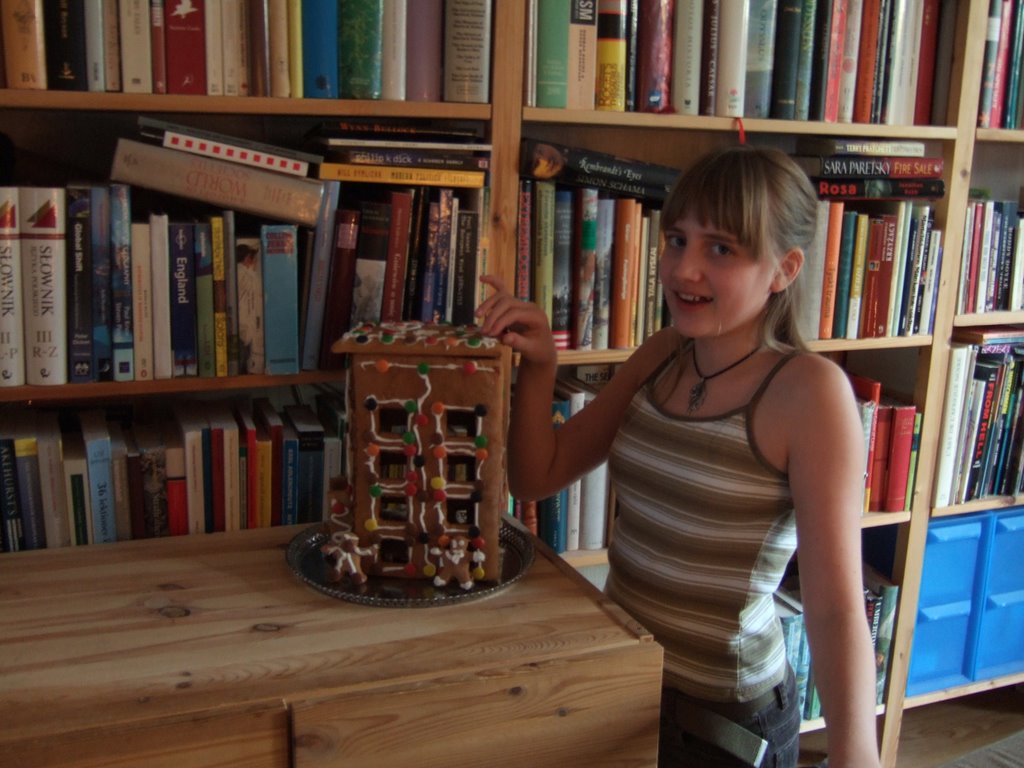
Allow me to start with a photo taken by my youngest daughter of my eldest daughter, posing with the gingerbread house we assembled on Christmas Eve. It's quite crooked (mea culpa) and the photo isn't too great (sua culpa, but sure she's only nine and a half and anyway I can't work the camera at all). Also available in photo for perusal - a sample selection of our books. See those big white volumes on the left? The Polish dictionary? My husband lugged those home from Poland years ago, unwrapped them, and discovered that a huge section of the P:s is missing. But we still keep it, because all the other letters of the alphabet are there, and every few years he looks something up.
Peter Dickinson: Perfect Gallows
A rather unique story, as the detective part is very much by-the-by. The main character is a celebrated actor, who has cause to remember how he once started out during the War. He is a ruthless person, who for the sake of his art uses people around him as he wants, and drops them as soon as they can't serve him any longer. One of the few people he genuinely liked, the black servant Samuel, apparently killed himself during the war, but the actor has always known he was murdered. He just chose not to mention any suspicions for fear of jeopardizing his budding career. So the novel is about the events leading up to the murder, but it's not about the crime per se, or solving it. It's well written though - also, it's another of Dickinson's racial tension novels; this seems to be a theme with him.
Josephine Tey: The Expensive Halo
Oh, I do like a Josephine Tey. She didn't write nearly enough. I thought this was another detective story, but it's not. However, since someone bursts out with "oh, it's a wonder no-one murdered Father long ago" somewhere in the first third of the book I really thought there would be a murder later on for aaaages, but there wasn't...
It's a lovely "period piece" about two siblings who, independant of one another, get involved with another brother and sister from a higher class of society. Tey captures the 1930s ennui of the upper-class youth beautifully. It's in some ways a very modern book, as we in general don't expect an author of this age to be so outspoken. There is a reference to someone trying cocaine now, the new thing. Also
She had four absorbing interests in life: contraception, the price of boiling beef, the rent money, and the Duchess of York.
"Some of my best friends are musicians. It's the crowd who hang around them I can't bear. Perhaps camp followers are always a despicable bunch. Even a prostitute is better than a pimp, I suppose. [...]"The poor siblings are tormented by their choleric, religious, hypocritical father, and are desperate to get away, but remain under his roof for the sake of their mother. Women's rights are an important theme, and independance in general. It makes one sad to think that the war was only eight years away.
Ngaio Marsh: Light Thickens
This is the Dame's last novel, she died that very year. It's a novel mostly about Macbeth, with a murder at the end. But Macbeth is at the centre of things, in particular theatre production of the play. It's very charming, because her love of Shakespeare and theatre shines out on every page. We revisit the Dolphin theatre, a theatre than reappears frequently in her books, and even Pergrine Jay, whom we first met as the budding playwright in Death at the Dolphin. Now he is a respected director and owner of the place. It's a fine end to a distinguished writing career.
Wednesday, November 29, 2006
More work-reading
I found two Ngaio Marshes that I hadn't read in the section for Large Print. It's a kick-ass section, enabling you to borrow books that you can prop up and read from across the room. No, I exaggerate, but almost.
Death In A White Tie:
This one is set in the late 1930s (first published 1938). Alleyn has a mahoosive crush on Troy, and they've had a good few run-ins in previous novels we deduce (our library is sadly understocked). This is a subplot to the main plot, which is a blackmailer at large in Society, during the débutante season to boot. Alleyn asks a friend to keep an eye open for this blackmailer, and the friend promptly gets himself killed. Alleyn's mother features a lot, which is nice, and we can note that Fox isn't yet committed to learning French.
I liked this one, it has some nice hints at the political situation brewing in Europe, with a Jewish débutante being harrassed by her chaperone among other things.
Opening Night:
...and this one was written more than ten years later. It's set in the world of theatre, a well-known Marsh theme. She does it well, too. It's one of those novels that has a long build-up to the crime, then Alleyn steps in, and since the crime isn't really complicated he solves it in a matter of hours. I mean, the crime-solving is not the main issue in this cathegory of Alleyn novels, it's a story about the people around it really. Not deep psychological stuff or anything, just a different slant to the whodunnit. Our heroine here is a young New Zealander who has come to London to act. Bad luck befalls her, and she stumbles upon a job as dresser to a star, and immediately takes it. The theater troupe is stressed over opening night and riddled with conflict, and her introduction into the close group causes more.
Not a bad book, but not a favourite. Of course, I do always get a kick out of how Marsh brings up "the homosexual issue" in her theatre novels (for lack of a better term). It must have been quite gutsy of her to dare allude to it in those censorious times.
And then I found a new Kathy Reichs! Break No Bones has Temperance working an archaeology site in South Carolina with a group of students. They uncover a more recently dead body, and events are set in motion. It's a decent Brennan novel, I like the banter, the emotional drive and the... well, reality of Reich's stories. Tempe Brennan feels nice and real. So I was sadly reminded of how disappointed I was in the TV series Bones, in which all the characters and even the actual work feels so false and show-cased. Bleurgh.
I tried reading another Ben Elton, one called High Society, all about drugs, but it bored me so I gave up. Life's too short.
In a panicky frame of mind I picked up a very classic, basic whodunnit by Patricia Moyes. Down Among The Dead Men is about a small village/town in England that attracts sailing folks, and where there has been a robbery and a death, seemingly unrelated, but aha! Chief Inspector Henry Tibbett sees more than meets the eye, and ruins his holiday by picking at the scab.
I read this right after reading Peter Dickinson novels, and was slightly shell-shocked at the simplicity, or rather blandness, of a book like this. It isn't terribly good at all, but it does have all those whodunnit triggers, so if you enjoy keeping track of the clues and working out who the murderer is thusly you might like it. I spotted the murderer anyway, without remembering diddly about tides, because it's the type of books where it's obvious.
And this brings me, last but not least, to said Peter Dickinson. First Play Dead, the second of his I've read with a female heroine (the first being The Lively Dead, which I never really wrote about..). It's always refreshing with a male author who can portray women well, not many can. It's more linear than I'm used to with PD, which makes it easier to follow and get "into", obviously. Poppy child-minds her grandson, and is involved in a local playgroup. One day a man is watching them, and then follows Poppy on the way home. Although she manages to lose him, the playgroup is in outrage over what is thought to be a paedophile, and when he turns up murdered even the nannies become suspects. Of course there are more twists, since this is a Dickinson novel and all. It's very enjoyable. He's brilliant at giving you all the clues in the first five pages, in off-hand conversation, and then making them relevant towards the end.
Then Walking Dead, set in the Caribbean. The island dictatorship we visit here was previously mentioned in The Lizard In The Cup, which I read just the other week but seem to have forgotten to blog about! Shame on me. Anyway, our hero David Foxe is a scientist, who via this and that is forced by the island's tyrant to conduct experiments on humans. However, he has with him a laboratory rat who by the believers in the local Voodoo-esque religion is perceived as a symbol of the Sunday Dwarf, and this gives our hero a lot of power.
While reading this novel I reflected on how it isn't possible now to write about black people or, let us say, other cultures in the way Dickinson does here. To Foxe, the islanders are alien in culture. Almost completely. He starts out thinking their beliefs are grotesque. But that's okay. It's a very honest way of looking at things - to an outsider things are strange and ununderstandable. It doesn't make these natives less human though. Foxe doesn't despise them. I'm not explaining myself well, because my brain is dead, but I couldn't help thinking that nowadays it's so hard to be brutal like that, since we're afraid to offend.
Death In A White Tie:
This one is set in the late 1930s (first published 1938). Alleyn has a mahoosive crush on Troy, and they've had a good few run-ins in previous novels we deduce (our library is sadly understocked). This is a subplot to the main plot, which is a blackmailer at large in Society, during the débutante season to boot. Alleyn asks a friend to keep an eye open for this blackmailer, and the friend promptly gets himself killed. Alleyn's mother features a lot, which is nice, and we can note that Fox isn't yet committed to learning French.
I liked this one, it has some nice hints at the political situation brewing in Europe, with a Jewish débutante being harrassed by her chaperone among other things.
Opening Night:
...and this one was written more than ten years later. It's set in the world of theatre, a well-known Marsh theme. She does it well, too. It's one of those novels that has a long build-up to the crime, then Alleyn steps in, and since the crime isn't really complicated he solves it in a matter of hours. I mean, the crime-solving is not the main issue in this cathegory of Alleyn novels, it's a story about the people around it really. Not deep psychological stuff or anything, just a different slant to the whodunnit. Our heroine here is a young New Zealander who has come to London to act. Bad luck befalls her, and she stumbles upon a job as dresser to a star, and immediately takes it. The theater troupe is stressed over opening night and riddled with conflict, and her introduction into the close group causes more.
Not a bad book, but not a favourite. Of course, I do always get a kick out of how Marsh brings up "the homosexual issue" in her theatre novels (for lack of a better term). It must have been quite gutsy of her to dare allude to it in those censorious times.
And then I found a new Kathy Reichs! Break No Bones has Temperance working an archaeology site in South Carolina with a group of students. They uncover a more recently dead body, and events are set in motion. It's a decent Brennan novel, I like the banter, the emotional drive and the... well, reality of Reich's stories. Tempe Brennan feels nice and real. So I was sadly reminded of how disappointed I was in the TV series Bones, in which all the characters and even the actual work feels so false and show-cased. Bleurgh.
I tried reading another Ben Elton, one called High Society, all about drugs, but it bored me so I gave up. Life's too short.
In a panicky frame of mind I picked up a very classic, basic whodunnit by Patricia Moyes. Down Among The Dead Men is about a small village/town in England that attracts sailing folks, and where there has been a robbery and a death, seemingly unrelated, but aha! Chief Inspector Henry Tibbett sees more than meets the eye, and ruins his holiday by picking at the scab.
I read this right after reading Peter Dickinson novels, and was slightly shell-shocked at the simplicity, or rather blandness, of a book like this. It isn't terribly good at all, but it does have all those whodunnit triggers, so if you enjoy keeping track of the clues and working out who the murderer is thusly you might like it. I spotted the murderer anyway, without remembering diddly about tides, because it's the type of books where it's obvious.
And this brings me, last but not least, to said Peter Dickinson. First Play Dead, the second of his I've read with a female heroine (the first being The Lively Dead, which I never really wrote about..). It's always refreshing with a male author who can portray women well, not many can. It's more linear than I'm used to with PD, which makes it easier to follow and get "into", obviously. Poppy child-minds her grandson, and is involved in a local playgroup. One day a man is watching them, and then follows Poppy on the way home. Although she manages to lose him, the playgroup is in outrage over what is thought to be a paedophile, and when he turns up murdered even the nannies become suspects. Of course there are more twists, since this is a Dickinson novel and all. It's very enjoyable. He's brilliant at giving you all the clues in the first five pages, in off-hand conversation, and then making them relevant towards the end.
Then Walking Dead, set in the Caribbean. The island dictatorship we visit here was previously mentioned in The Lizard In The Cup, which I read just the other week but seem to have forgotten to blog about! Shame on me. Anyway, our hero David Foxe is a scientist, who via this and that is forced by the island's tyrant to conduct experiments on humans. However, he has with him a laboratory rat who by the believers in the local Voodoo-esque religion is perceived as a symbol of the Sunday Dwarf, and this gives our hero a lot of power.
While reading this novel I reflected on how it isn't possible now to write about black people or, let us say, other cultures in the way Dickinson does here. To Foxe, the islanders are alien in culture. Almost completely. He starts out thinking their beliefs are grotesque. But that's okay. It's a very honest way of looking at things - to an outsider things are strange and ununderstandable. It doesn't make these natives less human though. Foxe doesn't despise them. I'm not explaining myself well, because my brain is dead, but I couldn't help thinking that nowadays it's so hard to be brutal like that, since we're afraid to offend.
Wednesday, June 28, 2006
Ngaio Marsh: Enter A Murderer
Goodness, had forgotten I had bought this! Was very pleased to spot it in the bookshelf this weekend, waiting for me to remember. Right next to the phone (that had stopped working, again, dammit. We're phonedicapped here. Telephonically challenged. I can't understand it.).
This is her second Marsh novel, from 1935, although I have a late Fontana edition from -74 (with a fugtastic cover). Alleyn still has Bathgate the journalist as a sidekick, but Fox is becoming quite prominent (which is good, because I like Fox), and is referred to as Foxkin a lot, but not as Bre'er Fox. FYI.
Bathgate takes Alleyn to a play, in which a man is to be shot in the final scene. Naturally the stage gun is not loaded with blanks this time, but with real bullets, and everyone on stage has had motive and opportunity for switching the bullets.
Best thing with this book is the references to the drug trade. There really is nothing new under the sun. At the core of the plot is smuggling and selling of heroine and cocaine. Drugs are dope, and when you're high on them you're dopey. It all seems almost quaint in its 1930s setting.
This is her second Marsh novel, from 1935, although I have a late Fontana edition from -74 (with a fugtastic cover). Alleyn still has Bathgate the journalist as a sidekick, but Fox is becoming quite prominent (which is good, because I like Fox), and is referred to as Foxkin a lot, but not as Bre'er Fox. FYI.
Bathgate takes Alleyn to a play, in which a man is to be shot in the final scene. Naturally the stage gun is not loaded with blanks this time, but with real bullets, and everyone on stage has had motive and opportunity for switching the bullets.
Best thing with this book is the references to the drug trade. There really is nothing new under the sun. At the core of the plot is smuggling and selling of heroine and cocaine. Drugs are dope, and when you're high on them you're dopey. It all seems almost quaint in its 1930s setting.
Saturday, November 19, 2005
Ngaoi Marsh: Black As He's Painted
I wanted to write a longer entry about this novel, but I'm finding it hard to concentrate. :-/ So I'll just write something then, because I'm already half-way through the next book and I have to remember to blog, or I can't keep track of what I read...
This is a novel from -74, and full of drug references, hippiesque characters, racial tension and loss of empire. Interesting to note is that the censorship must have lightened up, since Marsh can state openly that someone is a homosexual. I'm confused as to her attitude against homosexuals - the character in BAHP is evil and ridiculous, the steward in SITS was camp and sort of pathetic, in previous books I've noted that they are often theatrical and OTT... being, as she was, involved in the theatrical world (a recurring theme) she must have met many gay men. It seems as though she accepts their existence quite matter-of-factly, but they are still Not Normal. Like I said, it would be interesting to read a study on gay characters in her novels.
Storyline - Alleyn's old school chum is now President of his home country, Ng'ombwana. Yes, yes, Marsh commits the terrible sin of making up a country for the story. *sigh* She pulls it off quite well and has obviously done some research, but nevertheless... Me no likee. Anyway, he's coming to London, and his Ambassador and the Secret Service are all a-fluster over security, as the President has many enemies, tends not to respect security advice and has already survived two murder attempts.
The novel centres around racism, I'd say. Troy and Alleyn are "black-friendly". Remember, Troy made a black friend in Clutch of Constables (q.v., I'd link to it if I understood how to do so...). Nevertheless, they don't seem to be outraged at the blatant racism they encounter from other people. Stiff upper lip and all that, the black people simply have to accept that they are disliked by some. At one point in the novel a man says that he knows his assailant was black, even though it was pitch dark, because of the smell. Alleyn replies, or rebukes him, saying that apparently black people feel the same about us white people. However, Alleyn cheerily refers to black people as "woolly-headed" for example, and wonders how much resentment his old chum still nurses in his "sooty bosom". And Marsh writes that "nobody can look as bored as a Negro" - although the other n-word is banned and only used by blatant racists.
I guess times have changed... This is another area for academic study, probably.
Favourite witticism: Alleyn's and Fox' way of referring to the secret society that use a pottery fish as their symbol - they are the "Ku-Klux-Fish".
This is a novel from -74, and full of drug references, hippiesque characters, racial tension and loss of empire. Interesting to note is that the censorship must have lightened up, since Marsh can state openly that someone is a homosexual. I'm confused as to her attitude against homosexuals - the character in BAHP is evil and ridiculous, the steward in SITS was camp and sort of pathetic, in previous books I've noted that they are often theatrical and OTT... being, as she was, involved in the theatrical world (a recurring theme) she must have met many gay men. It seems as though she accepts their existence quite matter-of-factly, but they are still Not Normal. Like I said, it would be interesting to read a study on gay characters in her novels.
Storyline - Alleyn's old school chum is now President of his home country, Ng'ombwana. Yes, yes, Marsh commits the terrible sin of making up a country for the story. *sigh* She pulls it off quite well and has obviously done some research, but nevertheless... Me no likee. Anyway, he's coming to London, and his Ambassador and the Secret Service are all a-fluster over security, as the President has many enemies, tends not to respect security advice and has already survived two murder attempts.
The novel centres around racism, I'd say. Troy and Alleyn are "black-friendly". Remember, Troy made a black friend in Clutch of Constables (q.v., I'd link to it if I understood how to do so...). Nevertheless, they don't seem to be outraged at the blatant racism they encounter from other people. Stiff upper lip and all that, the black people simply have to accept that they are disliked by some. At one point in the novel a man says that he knows his assailant was black, even though it was pitch dark, because of the smell. Alleyn replies, or rebukes him, saying that apparently black people feel the same about us white people. However, Alleyn cheerily refers to black people as "woolly-headed" for example, and wonders how much resentment his old chum still nurses in his "sooty bosom". And Marsh writes that "nobody can look as bored as a Negro" - although the other n-word is banned and only used by blatant racists.
I guess times have changed... This is another area for academic study, probably.
Favourite witticism: Alleyn's and Fox' way of referring to the secret society that use a pottery fish as their symbol - they are the "Ku-Klux-Fish".
Tuesday, November 15, 2005
Ngaio Marsh: Singing In The Shrouds
Footnote for starters: I got a first edition of this novel, printed in 1958, and unfortunately there are a number of printing errors in it. Big ones, like substituting January with February. However, the book has been read by Uppsala Town Library's own private crime aficionado/proofreader, who's handwriting can be spotted in as good as every crime novel I've borrowed - making corrections, questioning deductions, commenting on storyline etc. Sometimes the PCA/PR makes mistakes in her (most likely it's her. I deduce this from the handwriting, my dear Watson) proofing, and, for example, misunderstands a colloquialism for a spelling error. I wonder if the PCA/PR is still alive. The remarks are, come to think of it, probably only found in the older books. Hm. RIP if you're dead, anonymous crime fiction fan!
This is the one in which a serial killer, moments after his third murder, sails off on a ship bound for South Africa. Roderick Alleyn joins the ship incognito and attempts to prevent a fourth victim. Features the usual Marsh stuff - letters from Alleyn home to Troy, a young couple falling in love, a theatrical character (this time someone who works in television! Must be the first TV celebrity she featured?) and a gay, flamboyant drama queen (a ship steward wannabe dancer). Marsh's homosexual characters are a subject wholly unto themselves, and I'd love to see someone do an academic study of it. Correct me if I'm wrong, but in those days there were "decency laws" in Britain that would prevent her from being too open about the matter. All she could therefore do was drop a hint that every reader would understand, such as:
" 'To make a vulgar practical joke out of what may have been the wretched little creature's tragedy - his own private, inexorable weakness - his devil!' " (Spoken by the conservative spinster.)
" Why the hell did the D-B have to dress up a queer steward [ ... ] " (Alleyn.)
Like I said, an academic study would be interesting. How widespread was the use of "queer" for "homosexual" in 1958? It does come across as ambigious.
Right, some typical Marsh quotes to finish off:
"They settled down to talk Anglo-Catholic shop.
Mrs. Cuddy, overhearing them, smelt Popery."
"She looked so dazzling that she sounded brilliant."
The woman's ace I tell you, ace.
This is the one in which a serial killer, moments after his third murder, sails off on a ship bound for South Africa. Roderick Alleyn joins the ship incognito and attempts to prevent a fourth victim. Features the usual Marsh stuff - letters from Alleyn home to Troy, a young couple falling in love, a theatrical character (this time someone who works in television! Must be the first TV celebrity she featured?) and a gay, flamboyant drama queen (a ship steward wannabe dancer). Marsh's homosexual characters are a subject wholly unto themselves, and I'd love to see someone do an academic study of it. Correct me if I'm wrong, but in those days there were "decency laws" in Britain that would prevent her from being too open about the matter. All she could therefore do was drop a hint that every reader would understand, such as:
" 'To make a vulgar practical joke out of what may have been the wretched little creature's tragedy - his own private, inexorable weakness - his devil!' " (Spoken by the conservative spinster.)
" Why the hell did the D-B have to dress up a queer steward [ ... ] " (Alleyn.)
Like I said, an academic study would be interesting. How widespread was the use of "queer" for "homosexual" in 1958? It does come across as ambigious.
Right, some typical Marsh quotes to finish off:
"They settled down to talk Anglo-Catholic shop.
Mrs. Cuddy, overhearing them, smelt Popery."
"She looked so dazzling that she sounded brilliant."
The woman's ace I tell you, ace.
Subscribe to:
Posts (Atom)