Showing posts with label Josephine Tey. Show all posts

Saturday, September 07, 2013

Almost 3 for the price of 1

So I read my first mapback, Death In Five Boxes by Carter Dickson. It is really not very good, but then I'm no Carter Dickson/John Dickson Carr fan. The mystery is contrived, the detective hero is exaggerated which makes him a charicature and not a character, and come to think of it not one character in the book is fleshed out enough to be a real, believable person. I trudged through it, mentally comparing it to The Singing Sands that I read just before and thinking Jesus, THERE IS NO COMPARISON yet Dickson's/Carr's name is often mentioned among the classics while Tey is more forgotten. It's the locked room thing. Him and his fecking locked rooms. Haha, just saw that Wikipedia has a great quote from a critic in its article on the book:
"As usual, Carter Dickson's plot is extremely complicated and it depends on a variety of gimmicks, most of which are barely plausible. One good one is the method of poisoning the White Lady cocktails without anybody's going near the shaker or the glasses. For the rest, the dialogue is in the worst style of false excitement and byplay, particularly the part allotted to the egregious Sir Henry Merrivale, who calls everybody "son" and yells "shut up" whenever he is stumped. The early portion is dull, the middle chaotic, and the end interminable."

Snigger.

Directly after Death in Five Boxes I picked up the other mapback, Rinehart's The Window at the White Cat and wow, immediately drawn in by engaging writing and characters - NO COMPARISON. I was actually so offended by how much more enjoyable these two women writers were compared to the one man that I put the book away thinking I'd postpone reading it until I could write a detailed, exhaustive, comparative analysis of the three books in manner of highly intelligent well-read academic person. Since this obviously isn't going to happen, unfortunately, we'll settle for just writing about them, shall we. And I'll just finish the damn book this week.

While I read The Singing Sands I made mental notes of about twenty places I'd have liked to quote, and now sadly it's been a while and I've forgotten. But it's just gorgeous. There are so many period details which make it so interesting if you're the slightest bit into retro, and Alan Grant is just fantastic. The books starts with him being on sick leave for panic attacks connnected with claustrophobia. He heads up to Scotland to his cousin and her husband. Just as he's getting off the train after a sleepless, tortured night, the carriage attendant discovers a dead body in one of the sleeping compartments. Grant can't let this mystery go, and thinking about it distracts him enough to help cure his, well, mental illness we'd say now. The mental illness is treated with respect and delicacy, all things considered. I see on Wikipedia that this was found among her papers after she died and published posthumously. How I wish, selfishly, that she'd lived and written more. I don't know how much this was edited before publishing, but it's pretty perfect and doesn't feel unfinished.

Monday, July 22, 2013

Not reading and re-reading

I "read" two books that I gave up on, one Simon Brett (The Murder in the Museum) which was as usual with a Brett mediocre and I have no tolerance for that type of nonsense at the moment so remind me not to bother ever again and am now re-reading Josephine Tey, The Singing Sands. I have a second hand copy with a ludicrous cover, viz.


Love the font, but the picture? Ha. I'll have to get back to a proper post on this, because I checked my archives and I haven't blogged about this one at all. It's worth a post.

Speaking of covers, one of the books I didn't read has a retro-cheesy cover deserving a photo, so I'm going to do a post for it later which is why I didn't bother writing more now.

 Reading Josephine Tey after Simon Brett is like ... like ... a drink of water when you're thirsty, if you'll excuse a worn metaphor. Such a difference in depth of writing. Brett must assume all his readers are pretty much illiterate. (I'm feeling snarky.)

Sunday, September 25, 2011

Nicola Upson: An Expert in Murder

I actually bought and read this after a tip here on the blog the other day, after I'd written about Josephine Tey (thanks oh swine of madness!). I got so curious, the library didn't have it and I realised they probably wouldn't get it either, so I thought what the hell. Treat myself even though it's an unknown quantity so to speak. Excellent service as per usual at The English Bookshop (link to the right), I ordered online and chose pick-up as delivery option. When I popped in for it your man in the shop said that he'd heard lots of great things about it and that the second one was supposed to be even better, so I was very favourably disposed towards the novel before ever cracking the spine. Although, luckily, not MADLY excited, thanks to the moderate wording of my internet tipper-offer there (a person I've internet-known for years and whose opinion I can trust, I feel) - " I quite enjoyed it, worth looking up for a bit of light fluff" she wrote, and I didn't really expect more then. Good for that, because if I had been I'd've been disappointed.

Friday, September 09, 2011

Josephine Tey: The Daughter of Time

Reread this today. Well, started earlier, but finished today. Read it years ago, but this copy was a gift from my cousin. It's a nice one, because it has the portrait of Richard III on the cover, which is helpful considering that the story starts with that and they keep referring to it. I love this, even though I do lose track of some of the historical characters. Mr Bani started to read it in an attempt at solidarity with my hobbies but he wasn't too keen apparently. Philistene. I wonder if the Babes in the Tower are ever mentioned in the tv series, The Tudors I mean? I think not, right, it starts with Henry VIII doesn't it? And it's his father who is the true murderer, according to Tey. Great book anyway.

Tuesday, December 26, 2006

All I read before and during Christmas


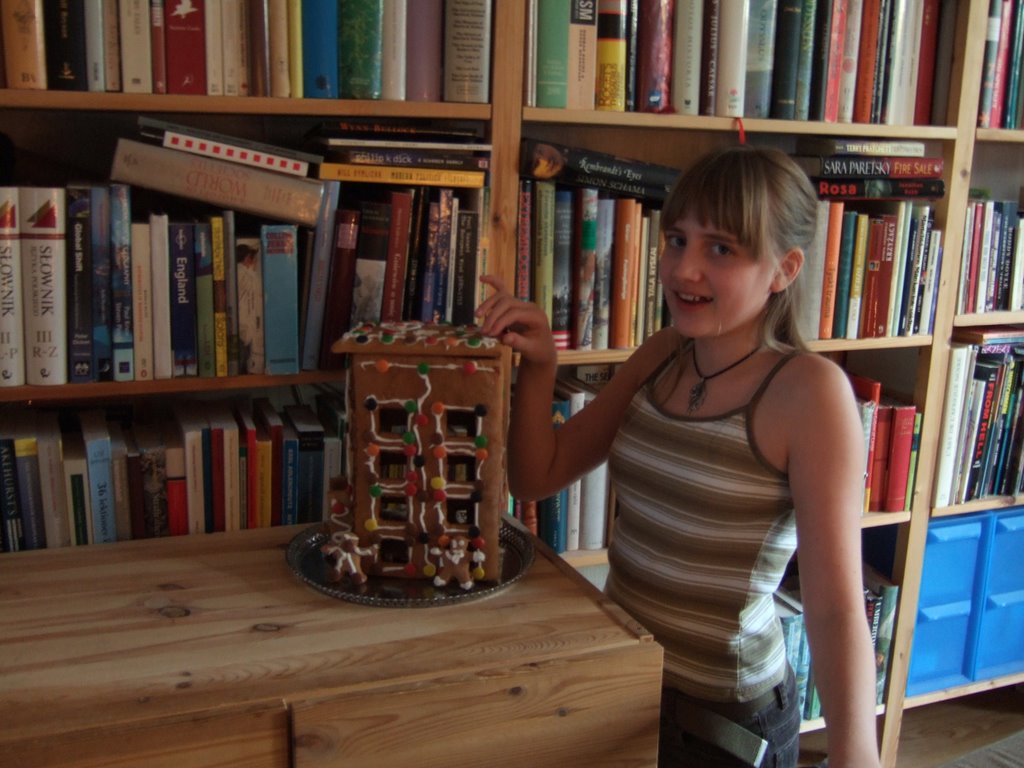
Allow me to start with a photo taken by my youngest daughter of my eldest daughter, posing with the gingerbread house we assembled on Christmas Eve. It's quite crooked (mea culpa) and the photo isn't too great (sua culpa, but sure she's only nine and a half and anyway I can't work the camera at all). Also available in photo for perusal - a sample selection of our books. See those big white volumes on the left? The Polish dictionary? My husband lugged those home from Poland years ago, unwrapped them, and discovered that a huge section of the P:s is missing. But we still keep it, because all the other letters of the alphabet are there, and every few years he looks something up.


Peter Dickinson: Perfect Gallows

A rather unique story, as the detective part is very much by-the-by. The main character is a celebrated actor, who has cause to remember how he once started out during the War. He is a ruthless person, who for the sake of his art uses people around him as he wants, and drops them as soon as they can't serve him any longer. One of the few people he genuinely liked, the black servant Samuel, apparently killed himself during the war, but the actor has always known he was murdered. He just chose not to mention any suspicions for fear of jeopardizing his budding career. So the novel is about the events leading up to the murder, but it's not about the crime per se, or solving it. It's well written though - also, it's another of Dickinson's racial tension novels; this seems to be a theme with him.

Josephine Tey: The Expensive Halo

Oh, I do like a Josephine Tey. She didn't write nearly enough. I thought this was another detective story, but it's not. However, since someone bursts out with "oh, it's a wonder no-one murdered Father long ago" somewhere in the first third of the book I really thought there would be a murder later on for aaaages, but there wasn't...

It's a lovely "period piece" about two siblings who, independant of one another, get involved with another brother and sister from a higher class of society. Tey captures the 1930s ennui of the upper-class youth beautifully. It's in some ways a very modern book, as we in general don't expect an author of this age to be so outspoken. There is a reference to someone trying cocaine now, the new thing. Also


She had four absorbing interests in life: contraception, the price of boiling beef, the rent money, and the Duchess of York.


"Some of my best friends are musicians. It's the crowd who hang around them I can't bear. Perhaps camp followers are always a despicable bunch. Even a prostitute is better than a pimp, I suppose. [...]"
The poor siblings are tormented by their choleric, religious, hypocritical father, and are desperate to get away, but remain under his roof for the sake of their mother. Women's rights are an important theme, and independance in general. It makes one sad to think that the war was only eight years away.

Ngaio Marsh: Light Thickens

This is the Dame's last novel, she died that very year. It's a novel mostly about Macbeth, with a murder at the end. But Macbeth is at the centre of things, in particular theatre production of the play. It's very charming, because her love of Shakespeare and theatre shines out on every page. We revisit the Dolphin theatre, a theatre than reappears frequently in her books, and even Pergrine Jay, whom we first met as the budding playwright in Death at the Dolphin. Now he is a respected director and owner of the place. It's a fine end to a distinguished writing career.