Wednesday, January 17, 2007
Ngaoi Marsh: Spinsters in Jeopardy
I'd forgotten this one, had to return it today because it was late. Bad Bani. It's not one of Marsh's best, but it had it's moments - not that I remember them well now, so they can't have been that great... Alleyn and Troy and their six-year-old son are on a holiday in France, which they've combined with work for Alleyn. The two missions (holiday and work) happen to come together when Troy is accidentally introduced to the mansion where the drug-dealing cult is based. And then their son is kidnapped. But it's all very British stiff-upper-lip in places.


Tuesday, January 16, 2007
Ian McEwan: Enduring Love
Another of mr Bani's buys. On the cover is a quote from Bill Bryson saying that it's "beautifully written" and "utterly compelling from the very first page". I suspect that Bryson is very attracted to our main character, Joe Rose, who is a scientist-turned-writer/television persona. Now, it is well written - but it ain't all that, all the same.
The storyline is that Joe Rose and his wife witness a hot-air balloon accident, resulting in one death. Another man present, Jed, meets Joe's eyes immediately afterwards, and this results in a sickly romantic fixation (on behalf of Jed, not Joe). So while Joe and his wife are trying to cope with the trauma of witnessing the tragedy and the guilt, they also have to cope with Jed stalking Joe. And Joe's wife is none too sure that it's not all in Joe's head, or that he isn't in some way causing it.
The novel starts out very philosophical. A lot of thinking, a lot of what-ifs and if-onlys. Sort of like Jonathan Safran Foer, whom I must now admit that I never finished reading (but I blame the fact that it was a translation and I never got sucked in). I liked this bit, and by the time it started becoming a more conventional thriller-type story I still had high hopes that it would be original, thanks to the pensive beginning. However, it doesn't live up to expectation IMO, but sort of peters out into a predictable showdown. And then we get some sort of epilogue that purports to be written by the psychologists in charge of Jed, who sum up the nature of his fixation, describe its causes and cures, and also slip in the "what happened next".
I'm not sure what to make of that. I usually quite like that kind of genre-mixing, but I was disappointed this time.
The storyline is that Joe Rose and his wife witness a hot-air balloon accident, resulting in one death. Another man present, Jed, meets Joe's eyes immediately afterwards, and this results in a sickly romantic fixation (on behalf of Jed, not Joe). So while Joe and his wife are trying to cope with the trauma of witnessing the tragedy and the guilt, they also have to cope with Jed stalking Joe. And Joe's wife is none too sure that it's not all in Joe's head, or that he isn't in some way causing it.
The novel starts out very philosophical. A lot of thinking, a lot of what-ifs and if-onlys. Sort of like Jonathan Safran Foer, whom I must now admit that I never finished reading (but I blame the fact that it was a translation and I never got sucked in). I liked this bit, and by the time it started becoming a more conventional thriller-type story I still had high hopes that it would be original, thanks to the pensive beginning. However, it doesn't live up to expectation IMO, but sort of peters out into a predictable showdown. And then we get some sort of epilogue that purports to be written by the psychologists in charge of Jed, who sum up the nature of his fixation, describe its causes and cures, and also slip in the "what happened next".
I'm not sure what to make of that. I usually quite like that kind of genre-mixing, but I was disappointed this time.
Joyce Carol Oates: Mother Missing
I believe this novel has earned Oates lots of praise. My sister lent it to me, and said that she wasn't too impressed by it, she found it too childish. At the time I didn't really see what she meant, but then I haven't read much Oates, only Big Mouth, Ugly Girl which is aimed at teens. I remembered a sort of childish style, but figured it was the genre (teen lit). Now I do see what she means. As an adult novel this comes across as a bit flat and over-simple. I don't know if I find it that strong and powerful as some of the reviewers seem to have done!
Nikki Eaton likes her life as the black sheep of the family, she loves her mother but is exasperated by her unspoken and spoken demands. One day she comes home and finds her mother murdered. The rest of the novel is about Nikki (and to a certain extent her goody-goody sister) coping with the grief, and also about Nikki discovering some things about her mother she never imagined. There is an idea in the book that it's good to be nice - Nikki's mother was very nice and caring, with empathy for the most stray of creatures - but it's not that well explored. In my opinion it's one of the books most interesting themes, but it gets lost a bit.
It's clearly quite personal though, and I did have the odd cry. Bits are more emotionally compelling than others.
Nikki Eaton likes her life as the black sheep of the family, she loves her mother but is exasperated by her unspoken and spoken demands. One day she comes home and finds her mother murdered. The rest of the novel is about Nikki (and to a certain extent her goody-goody sister) coping with the grief, and also about Nikki discovering some things about her mother she never imagined. There is an idea in the book that it's good to be nice - Nikki's mother was very nice and caring, with empathy for the most stray of creatures - but it's not that well explored. In my opinion it's one of the books most interesting themes, but it gets lost a bit.
It's clearly quite personal though, and I did have the odd cry. Bits are more emotionally compelling than others.
Michael Innes: A Connoisseur's Case
A rather early one.
Appleby and his wife Judith visit an old uncle, and stumble across the murder of an old man who recently returned to the neighbourhood from Canada. I can't be arsed to go into detail here, the memory of it has almost faded by now, I read it weeks ago... anyway, there is a mansion and a canal tunnel and a pub owner... I dunno, it was enjoyable, but fleetingly so.
Appleby and his wife Judith visit an old uncle, and stumble across the murder of an old man who recently returned to the neighbourhood from Canada. I can't be arsed to go into detail here, the memory of it has almost faded by now, I read it weeks ago... anyway, there is a mansion and a canal tunnel and a pub owner... I dunno, it was enjoyable, but fleetingly so.
So, The Scarlet Letter
I didn't enjoy this as much as I did Silas Marner, I'll admit, but it was still an good read. Personally I found Hawthorne's style a little too wordy and lumbered. That said - does one ever feel the wings of history beating about one's ears while reading this book! I didn't know anything about Hawthorne, so his biographical information was tremendously interesting - like, how his ancestor was a judge during the Salem trials. It's quite unusual in an American author to find this sense of being burdened by history, being tied to a particular place on the continent, rooted.
The story is of a Puritan town, in which a woman living without her husband becomes pregnant and gives birth to a girl. She is accused and condemned of adultery, but refuses to say who the child's father is. Her sentence is to always wear a capital A pinned on her clothing. Perversely (in the original sense of the word), she sews her A in scarlet, and embroiders it finely (she is an expert needlewoman). In time her humility and moral fibre lead to people starting to view the A as a badge of honour rather than dishonour.
I was thinking that this could make a rather fine film (thus eliminating the wordiness). A friend of mine claimed it had been filmed, with Demi Moore and Gary Oldman - I remember that monstrosity vaguely, and to me it doesn't have much to do with the spirit of the book that I'd like portrayed on the screen. The Demi Moore one is some sort of action flick. I'd like a more thoughtful tale, about the moral anguish the adulterers go through. After all, Hester admits she is a sinner. She doesn't resent her punishment on the grounds that what she did wasn't a sin and thus punishable. She wishes to be reminded of the fact that she was weak. This is a fascinating mindset to explore. Possibly someone like Tykwer could manage it.
The story is of a Puritan town, in which a woman living without her husband becomes pregnant and gives birth to a girl. She is accused and condemned of adultery, but refuses to say who the child's father is. Her sentence is to always wear a capital A pinned on her clothing. Perversely (in the original sense of the word), she sews her A in scarlet, and embroiders it finely (she is an expert needlewoman). In time her humility and moral fibre lead to people starting to view the A as a badge of honour rather than dishonour.
I was thinking that this could make a rather fine film (thus eliminating the wordiness). A friend of mine claimed it had been filmed, with Demi Moore and Gary Oldman - I remember that monstrosity vaguely, and to me it doesn't have much to do with the spirit of the book that I'd like portrayed on the screen. The Demi Moore one is some sort of action flick. I'd like a more thoughtful tale, about the moral anguish the adulterers go through. After all, Hester admits she is a sinner. She doesn't resent her punishment on the grounds that what she did wasn't a sin and thus punishable. She wishes to be reminded of the fact that she was weak. This is a fascinating mindset to explore. Possibly someone like Tykwer could manage it.
Friday, January 05, 2007
A classic: Silas Marner by George Eliot
One of those books that we've owned for ages, and I never read it, thinking that ah sure, it won't run away. Plus I thought it was a depressing book. For some reason. About misery and stuff.
But I was wrong. It's an adorable little story about a lonely weaver who lives for his money, and is devastated when it is stolen. Then chance sends him a little orphan to care for, instead of his gold. It's moral, and suffused with good. I loved it. We have a Wordsworth edition, and as you may know they come with very good introductions written by Clever People, and I even enjoyed that - it truly enhanced my reading experience. So now, on a classics kick, I'm reading The Scarlet Letter by Nathaniel Hawthorne, another book I've always assumed was on some dull subject, but it isn't. I haven't gotten that far yet, but I already stand corrected.
Right, that's all I'm able for today.
But I was wrong. It's an adorable little story about a lonely weaver who lives for his money, and is devastated when it is stolen. Then chance sends him a little orphan to care for, instead of his gold. It's moral, and suffused with good. I loved it. We have a Wordsworth edition, and as you may know they come with very good introductions written by Clever People, and I even enjoyed that - it truly enhanced my reading experience. So now, on a classics kick, I'm reading The Scarlet Letter by Nathaniel Hawthorne, another book I've always assumed was on some dull subject, but it isn't. I haven't gotten that far yet, but I already stand corrected.
Right, that's all I'm able for today.
Tuesday, December 26, 2006
All I read before and during Christmas
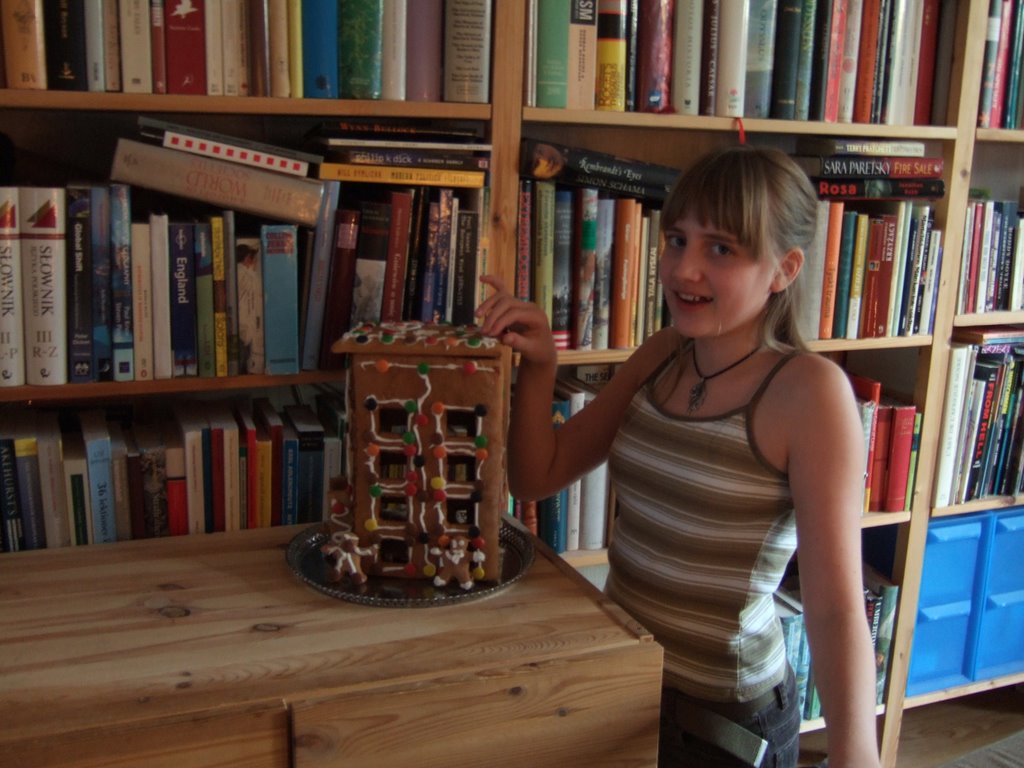
Allow me to start with a photo taken by my youngest daughter of my eldest daughter, posing with the gingerbread house we assembled on Christmas Eve. It's quite crooked (mea culpa) and the photo isn't too great (sua culpa, but sure she's only nine and a half and anyway I can't work the camera at all). Also available in photo for perusal - a sample selection of our books. See those big white volumes on the left? The Polish dictionary? My husband lugged those home from Poland years ago, unwrapped them, and discovered that a huge section of the P:s is missing. But we still keep it, because all the other letters of the alphabet are there, and every few years he looks something up.
Peter Dickinson: Perfect Gallows
A rather unique story, as the detective part is very much by-the-by. The main character is a celebrated actor, who has cause to remember how he once started out during the War. He is a ruthless person, who for the sake of his art uses people around him as he wants, and drops them as soon as they can't serve him any longer. One of the few people he genuinely liked, the black servant Samuel, apparently killed himself during the war, but the actor has always known he was murdered. He just chose not to mention any suspicions for fear of jeopardizing his budding career. So the novel is about the events leading up to the murder, but it's not about the crime per se, or solving it. It's well written though - also, it's another of Dickinson's racial tension novels; this seems to be a theme with him.
Josephine Tey: The Expensive Halo
Oh, I do like a Josephine Tey. She didn't write nearly enough. I thought this was another detective story, but it's not. However, since someone bursts out with "oh, it's a wonder no-one murdered Father long ago" somewhere in the first third of the book I really thought there would be a murder later on for aaaages, but there wasn't...
It's a lovely "period piece" about two siblings who, independant of one another, get involved with another brother and sister from a higher class of society. Tey captures the 1930s ennui of the upper-class youth beautifully. It's in some ways a very modern book, as we in general don't expect an author of this age to be so outspoken. There is a reference to someone trying cocaine now, the new thing. Also
She had four absorbing interests in life: contraception, the price of boiling beef, the rent money, and the Duchess of York.
"Some of my best friends are musicians. It's the crowd who hang around them I can't bear. Perhaps camp followers are always a despicable bunch. Even a prostitute is better than a pimp, I suppose. [...]"The poor siblings are tormented by their choleric, religious, hypocritical father, and are desperate to get away, but remain under his roof for the sake of their mother. Women's rights are an important theme, and independance in general. It makes one sad to think that the war was only eight years away.
Ngaio Marsh: Light Thickens
This is the Dame's last novel, she died that very year. It's a novel mostly about Macbeth, with a murder at the end. But Macbeth is at the centre of things, in particular theatre production of the play. It's very charming, because her love of Shakespeare and theatre shines out on every page. We revisit the Dolphin theatre, a theatre than reappears frequently in her books, and even Pergrine Jay, whom we first met as the budding playwright in Death at the Dolphin. Now he is a respected director and owner of the place. It's a fine end to a distinguished writing career.
Saturday, December 23, 2006
Visserligen har jag läst...
... men än viktigare: jag träffade på Frida som hastigast och vi jämförde magar. Det gick utmärkt eftersom vi råkade ha på oss samma mammabyxor (H&M, what can we say). Svårt att säga vems mage som var störst, Frida är ju lite mindre än jag dårå, så proportionerna blir fel (men jag tror nog jag var lite större, suck).
Troligen hinner jag inte blogga på riktigt förrän i mellandagarna (the inbetween days), så jag får önska alla läsare en trevlig helg...
Troligen hinner jag inte blogga på riktigt förrän i mellandagarna (the inbetween days), så jag får önska alla läsare en trevlig helg...
Sunday, December 17, 2006
Oh. My. God.
Lookee what I found. A King/McDermid novel! I don't read enough news at all. I'd completely missed this! This is what I want for Christmas! Except they don't have it in. *sigh*
Aaaaand we're sinking again
I've got a pile of books from the library to plow through next week at work, so I'd better blog about the last ones from last week before I start. Last week before Christmas, thanks be to Jesus, I don't know if I can take much more... I don't know why all manner of shite has to happen before Christmas, I really don't.
I've read two Michael Innes - not the two best ones I feel. I suspect the earlier work is the best, so I went rooting in the library cellar for older novels, and found a few. Give them a try and then see. I'm down to re-reading all the crime fic I like otherwise I think. The Art of Detection, Laurie R. King's latest is constantly out or reserved. Hey, I'll tell my eldest I want it for Christmas! She did ask.... but she can only afford a paperback, so I may see if that's out yet. Surely not already? I'll just have to wait...
Back to Innes. Death at the Chase features Innes major hero Lord Appleby, nowadays retired from Scotland Yard. Out walking he comes across a local character, convinced he's being persecuted and that his life is threatened over something that happened in France during the war. Appleby witnesses an attempt upon his life, and gets suckered in. Coincidentally his son Bobby also has business with the old man via a new friend. Not the best of books at all. An Awkward Lie also has Bobby cast as the lead, this time he finds a body in a bunker while playing a mornig round of golf. When the body is gone by the time the police get there he wants to clear his name in case he's perceived as a liar. Also forgettable. Although I'd rather read these than say Lisa Marklund. But hey...
Currently I've almost finished 'Tis, the sequel to Angela's Ashes by Frank McCourt. It's not as good as Angela's Ashes, but it's still a good read, a story that wanted to be told. Angela's Ashes flows better though, and is more well-defined since it ends so well when he goes off back to New York. 'Tis is more vague in its temporal boundaries, and kind of just keeps going. I'd still recommend it though, for people who want to understand the Irish psyche - that psyche I'm touched by myself and desperate to understand...
Good hopes for next weeks reading - found some Ngaio Marsh and Josephine Tey in the cellar apart from the Michael Innes, so that's promising. Those two ladies have all the men whipped.
I've read two Michael Innes - not the two best ones I feel. I suspect the earlier work is the best, so I went rooting in the library cellar for older novels, and found a few. Give them a try and then see. I'm down to re-reading all the crime fic I like otherwise I think. The Art of Detection, Laurie R. King's latest is constantly out or reserved. Hey, I'll tell my eldest I want it for Christmas! She did ask.... but she can only afford a paperback, so I may see if that's out yet. Surely not already? I'll just have to wait...
Back to Innes. Death at the Chase features Innes major hero Lord Appleby, nowadays retired from Scotland Yard. Out walking he comes across a local character, convinced he's being persecuted and that his life is threatened over something that happened in France during the war. Appleby witnesses an attempt upon his life, and gets suckered in. Coincidentally his son Bobby also has business with the old man via a new friend. Not the best of books at all. An Awkward Lie also has Bobby cast as the lead, this time he finds a body in a bunker while playing a mornig round of golf. When the body is gone by the time the police get there he wants to clear his name in case he's perceived as a liar. Also forgettable. Although I'd rather read these than say Lisa Marklund. But hey...
Currently I've almost finished 'Tis, the sequel to Angela's Ashes by Frank McCourt. It's not as good as Angela's Ashes, but it's still a good read, a story that wanted to be told. Angela's Ashes flows better though, and is more well-defined since it ends so well when he goes off back to New York. 'Tis is more vague in its temporal boundaries, and kind of just keeps going. I'd still recommend it though, for people who want to understand the Irish psyche - that psyche I'm touched by myself and desperate to understand...
Good hopes for next weeks reading - found some Ngaio Marsh and Josephine Tey in the cellar apart from the Michael Innes, so that's promising. Those two ladies have all the men whipped.
Sunday, December 10, 2006
Friday, December 08, 2006
Christopher Priest: The Prestige
As you all may know, this novel has recently been filmed. We've had it for a while - it's one of those books that just Appear, courtesy of mr Bani, who then proceeds to walk around muttering about all the books we have and how we need to clear the clutter. I swear, for every book I buy he buys fifteen. I decided to read it since my library stash was depleted, even though I didn't really think it would be my Thing. I'm not sure why... I didn't think the cover looked that appealing, and the storyline, about two rival magicians who feud over a trick... I dunno, it wasn't buzzing me. Turns out I was slightly mislead by having seen film trailers.
See, I thought this was a relatively straightforward, linear tale of exactly that, rival magicians, whose feud has impact on their lives and the lives of their loved ones. And possibly a conflict over a girl. Actually, the novel has a distinctly Edgar Allan Poe-ish theme - something that took me so by surprise that I didn't really want to see it. I thought it would be all about illusion and sleight-of-hand, i.e. that the amazing tricks worked would be exposed as illusions. However, there is mysterious machinery and scantily descriped nearly-science with devastating effects - but they are real, not illusion. I've enjoyed the crime fiction I've read with magic themes - Jeffrey Deaver's The Vanished Man and Carol O'Connell's Shell Game - and this did lead me to expact more dénouement (my mot de jour, it seems)... but it was not to be. So I was very disappointed about half-way through, but perhaps unfairly so, I admit it. Anyway, the film trailers point to a more linear, traditional story, so I was taken aback. It seems like some of this Poe-ish feel might well be in the film aswell though, but I haven't read spoilers - yet.
It's not a bad book at all, but the very end is a severe letdown. It goes nowhere, and we the readers are left hanging completely.
See, I thought this was a relatively straightforward, linear tale of exactly that, rival magicians, whose feud has impact on their lives and the lives of their loved ones. And possibly a conflict over a girl. Actually, the novel has a distinctly Edgar Allan Poe-ish theme - something that took me so by surprise that I didn't really want to see it. I thought it would be all about illusion and sleight-of-hand, i.e. that the amazing tricks worked would be exposed as illusions. However, there is mysterious machinery and scantily descriped nearly-science with devastating effects - but they are real, not illusion. I've enjoyed the crime fiction I've read with magic themes - Jeffrey Deaver's The Vanished Man and Carol O'Connell's Shell Game - and this did lead me to expact more dénouement (my mot de jour, it seems)... but it was not to be. So I was very disappointed about half-way through, but perhaps unfairly so, I admit it. Anyway, the film trailers point to a more linear, traditional story, so I was taken aback. It seems like some of this Poe-ish feel might well be in the film aswell though, but I haven't read spoilers - yet.
It's not a bad book at all, but the very end is a severe letdown. It goes nowhere, and we the readers are left hanging completely.
Thursday, December 07, 2006
I is working really hard
Edmund Crispin: The Glimpses of the Moon
I've read all the Crispin novels the library has to offer, and I need to remember that. I keep borrowing them thinking that I haven't, but I have. I have I have I have. And this one is the one with the pig's head - to help me remember. Not that they're not pleasant, it's just such a downer to think you have a virgin book and instead be left with... hang on, that was a bad metaphore getting worse. Forget it.
TGOTM has a cover proclaiming it to be "his first novel for over twenty years" and "well worth waiting for". It was published in -77, and must have been eagerly anticipated by his fans. Crispin has a very special (I was going to put "very unique", which would have been ironic as that is precisely the type of phrase that a Crispin book would take the piss out of, as something is either unique or not, right? so I changed my mind) style, very funny and literary, as the reviewers sometimes put it. For example:
I think this is hilarious. This is in the very beginning, and I giggled so hard I decided that the book had to be re-read. It's a good start, and we're thrown right in to the story, in which Gervase Fen, our professor and hero, has borrowed a cottage in a small village to get underway with his book on 20th century novelists. The murders interfere. They are actually incredibly gruesome, with decapitated and mutilated bodies, but they are covered with a sheet of Wodehouse-esque humour (I'm not claiming the humour is Wodehouse-esque. The Swedish library review on the inside cover is. I've never read Wodehouse, always been something unappealing about it to my mind. And now I want to even less, because I suspect the more Wodehouse in this Crispin, the less fun for me. It deteriorates into separate humouristic episodes that barely hang together. It's like reading one of those authors who is obviously desperate for his/her book to be filmed, and has the entire dialogue written in funny one-liners).
Let's see, what other notes did I make... From this book I learnt the names of the cow's four stomachs in English! Rumen, honeycomb, manyplies and abomasum. How odd are they??? I had some other potential quotes, but cannot be arsed. Must move on.
Michael Innes: The Ampersand Papers and Appleby's Answer
I randomly chose two Innes books too. They have in common some incredibly ignorant and hilariously funny (therefore) nobility, FYI. The Ampersand Papers is about possibly valuable literary manuscripts being stored in a delapidated castle tower for a lark, and Appleby's Answer is about a lady writer of detective fiction who provides a madman with a plot for murder - or not. I like Innes style, they are funny, literary (again, ha ha), and make you feel a bit smart, even though they aren't really a difficult read. The latter book also, possibly, contains a veiled P.D. James, as he writes about a woman who is considered the queen of detective fiction and used to work at the Foreign Office. A-ha, as Piglet tried to say.
Carter Dickson: The Ten Teacups
Carter Dickson is the same fella as John Dickson Carr, the master of the locked-room mystery. This is one such mystery, and a good one, if one knows about cricket pitching. He helpfully provides you with notes on where the clues to the solution where during the dénouement, which I find endearing.
Jeffrey Deaver: The Cold Moon
I was sort of watching the film version of The Bone Collector on the telly while I was reading this, and I was struck by how simple the film was compared to a Deaver novel, which will contain subplots in scores and red herrings in large quantities. In this one a serial killer appears called the Watchmaker - but of course all is not that simple, and I really don't want to say too much, as the transition from classic serial killer novel to a different kind of thriller is quite surprising and should be read if you enjoy this sort of thing.
But I will say this: it was OBVIOUS all along that Sachs wasn't going to quit cophood. God.
I've read all the Crispin novels the library has to offer, and I need to remember that. I keep borrowing them thinking that I haven't, but I have. I have I have I have. And this one is the one with the pig's head - to help me remember. Not that they're not pleasant, it's just such a downer to think you have a virgin book and instead be left with... hang on, that was a bad metaphore getting worse. Forget it.
TGOTM has a cover proclaiming it to be "his first novel for over twenty years" and "well worth waiting for". It was published in -77, and must have been eagerly anticipated by his fans. Crispin has a very special (I was going to put "very unique", which would have been ironic as that is precisely the type of phrase that a Crispin book would take the piss out of, as something is either unique or not, right? so I changed my mind) style, very funny and literary, as the reviewers sometimes put it. For example:
[...]"Gobbo!" the Major rapped out in an army voice. "Answer the question, please!"
Luckily Gobbo had never been in the forces, so this worked. "Ur," he said. The current had reversed course, and he was coming back inshore again. "Ur. Ur, ur." All at once a spasm of energy seized him. "Er never," he began recapitulating, doppio movimento, accelerando. "Er never killed en. And I'll tell 'ee fer why. Cuz," he coda-ed triumphantly, allegro assai, "I wer talkin' to en."
I think this is hilarious. This is in the very beginning, and I giggled so hard I decided that the book had to be re-read. It's a good start, and we're thrown right in to the story, in which Gervase Fen, our professor and hero, has borrowed a cottage in a small village to get underway with his book on 20th century novelists. The murders interfere. They are actually incredibly gruesome, with decapitated and mutilated bodies, but they are covered with a sheet of Wodehouse-esque humour (I'm not claiming the humour is Wodehouse-esque. The Swedish library review on the inside cover is. I've never read Wodehouse, always been something unappealing about it to my mind. And now I want to even less, because I suspect the more Wodehouse in this Crispin, the less fun for me. It deteriorates into separate humouristic episodes that barely hang together. It's like reading one of those authors who is obviously desperate for his/her book to be filmed, and has the entire dialogue written in funny one-liners).
Let's see, what other notes did I make... From this book I learnt the names of the cow's four stomachs in English! Rumen, honeycomb, manyplies and abomasum. How odd are they??? I had some other potential quotes, but cannot be arsed. Must move on.
Michael Innes: The Ampersand Papers and Appleby's Answer
I randomly chose two Innes books too. They have in common some incredibly ignorant and hilariously funny (therefore) nobility, FYI. The Ampersand Papers is about possibly valuable literary manuscripts being stored in a delapidated castle tower for a lark, and Appleby's Answer is about a lady writer of detective fiction who provides a madman with a plot for murder - or not. I like Innes style, they are funny, literary (again, ha ha), and make you feel a bit smart, even though they aren't really a difficult read. The latter book also, possibly, contains a veiled P.D. James, as he writes about a woman who is considered the queen of detective fiction and used to work at the Foreign Office. A-ha, as Piglet tried to say.
Carter Dickson: The Ten Teacups
Carter Dickson is the same fella as John Dickson Carr, the master of the locked-room mystery. This is one such mystery, and a good one, if one knows about cricket pitching. He helpfully provides you with notes on where the clues to the solution where during the dénouement, which I find endearing.
Jeffrey Deaver: The Cold Moon
I was sort of watching the film version of The Bone Collector on the telly while I was reading this, and I was struck by how simple the film was compared to a Deaver novel, which will contain subplots in scores and red herrings in large quantities. In this one a serial killer appears called the Watchmaker - but of course all is not that simple, and I really don't want to say too much, as the transition from classic serial killer novel to a different kind of thriller is quite surprising and should be read if you enjoy this sort of thing.
But I will say this: it was OBVIOUS all along that Sachs wasn't going to quit cophood. God.
Sunday, December 03, 2006
Ylva Elvin-Nowak: Världens bästa pappa?
The title of this book is in translation The World's Greatest Dad? I found it interesting enough to want to write about it in English, so all my readers can understand... (wink wink!) The author is a psychologist who for her doctoral thesis wrote about how Swedish mothers perceive their lives and roles (based on interviews), and this book is a sort of follow-up. She has interviewed 20 men about how they perceive fatherhood, how they have adjusted to it, what it means to them in everyday life etc.
One of the fundamental differences, she writes, is that women feel so much more guilty than men. To summarize, she argues that mothers today compare themselves to their mothers, who more often didn't work, and thus always come up short since they have more demands on their time. Whereas men also compare themselves to their fathers (who were rather more completely absent), and feel pretty damn good. She spotlights quite well how there is a different scale to measure good motherhood vs good fatherhood. A good mother always has to be a step ahead, a good father doesn't, he just has to deal with problems when they arise. Very interestingly, many fathers don't seem to get that everyday, hands-on responsability for their children until after a divorce, when they become sole caregiver half the time (in Sweden, I must add, it's quite common for children to live every other week with each parents after a separation).
Also, the book is illustrated with Berglin cartoons - always a bonus!
My favourite bit from the book has to be when one father says something to the effect of "it's always nice to see your kids grow up" and promises to take that month (!) of parental leave in the summer sometime. As the author says, a mother who said something similar would be seen as deranged. N.b. that in Sweden we have almost a year and a half of paid parental leave altogether...
I wanted to link here to the blog of a forum friend, who wrote about Spanish fathers a while back, but I can't find it at the moment. If/when I do, I'll come back and edit.
Edited - found link!
One of the fundamental differences, she writes, is that women feel so much more guilty than men. To summarize, she argues that mothers today compare themselves to their mothers, who more often didn't work, and thus always come up short since they have more demands on their time. Whereas men also compare themselves to their fathers (who were rather more completely absent), and feel pretty damn good. She spotlights quite well how there is a different scale to measure good motherhood vs good fatherhood. A good mother always has to be a step ahead, a good father doesn't, he just has to deal with problems when they arise. Very interestingly, many fathers don't seem to get that everyday, hands-on responsability for their children until after a divorce, when they become sole caregiver half the time (in Sweden, I must add, it's quite common for children to live every other week with each parents after a separation).
Also, the book is illustrated with Berglin cartoons - always a bonus!
My favourite bit from the book has to be when one father says something to the effect of "it's always nice to see your kids grow up" and promises to take that month (!) of parental leave in the summer sometime. As the author says, a mother who said something similar would be seen as deranged. N.b. that in Sweden we have almost a year and a half of paid parental leave altogether...
I wanted to link here to the blog of a forum friend, who wrote about Spanish fathers a while back, but I can't find it at the moment. If/when I do, I'll come back and edit.
Edited - found link!
Wednesday, November 29, 2006
More work-reading
I found two Ngaio Marshes that I hadn't read in the section for Large Print. It's a kick-ass section, enabling you to borrow books that you can prop up and read from across the room. No, I exaggerate, but almost.
Death In A White Tie:
This one is set in the late 1930s (first published 1938). Alleyn has a mahoosive crush on Troy, and they've had a good few run-ins in previous novels we deduce (our library is sadly understocked). This is a subplot to the main plot, which is a blackmailer at large in Society, during the débutante season to boot. Alleyn asks a friend to keep an eye open for this blackmailer, and the friend promptly gets himself killed. Alleyn's mother features a lot, which is nice, and we can note that Fox isn't yet committed to learning French.
I liked this one, it has some nice hints at the political situation brewing in Europe, with a Jewish débutante being harrassed by her chaperone among other things.
Opening Night:
...and this one was written more than ten years later. It's set in the world of theatre, a well-known Marsh theme. She does it well, too. It's one of those novels that has a long build-up to the crime, then Alleyn steps in, and since the crime isn't really complicated he solves it in a matter of hours. I mean, the crime-solving is not the main issue in this cathegory of Alleyn novels, it's a story about the people around it really. Not deep psychological stuff or anything, just a different slant to the whodunnit. Our heroine here is a young New Zealander who has come to London to act. Bad luck befalls her, and she stumbles upon a job as dresser to a star, and immediately takes it. The theater troupe is stressed over opening night and riddled with conflict, and her introduction into the close group causes more.
Not a bad book, but not a favourite. Of course, I do always get a kick out of how Marsh brings up "the homosexual issue" in her theatre novels (for lack of a better term). It must have been quite gutsy of her to dare allude to it in those censorious times.
And then I found a new Kathy Reichs! Break No Bones has Temperance working an archaeology site in South Carolina with a group of students. They uncover a more recently dead body, and events are set in motion. It's a decent Brennan novel, I like the banter, the emotional drive and the... well, reality of Reich's stories. Tempe Brennan feels nice and real. So I was sadly reminded of how disappointed I was in the TV series Bones, in which all the characters and even the actual work feels so false and show-cased. Bleurgh.
I tried reading another Ben Elton, one called High Society, all about drugs, but it bored me so I gave up. Life's too short.
In a panicky frame of mind I picked up a very classic, basic whodunnit by Patricia Moyes. Down Among The Dead Men is about a small village/town in England that attracts sailing folks, and where there has been a robbery and a death, seemingly unrelated, but aha! Chief Inspector Henry Tibbett sees more than meets the eye, and ruins his holiday by picking at the scab.
I read this right after reading Peter Dickinson novels, and was slightly shell-shocked at the simplicity, or rather blandness, of a book like this. It isn't terribly good at all, but it does have all those whodunnit triggers, so if you enjoy keeping track of the clues and working out who the murderer is thusly you might like it. I spotted the murderer anyway, without remembering diddly about tides, because it's the type of books where it's obvious.
And this brings me, last but not least, to said Peter Dickinson. First Play Dead, the second of his I've read with a female heroine (the first being The Lively Dead, which I never really wrote about..). It's always refreshing with a male author who can portray women well, not many can. It's more linear than I'm used to with PD, which makes it easier to follow and get "into", obviously. Poppy child-minds her grandson, and is involved in a local playgroup. One day a man is watching them, and then follows Poppy on the way home. Although she manages to lose him, the playgroup is in outrage over what is thought to be a paedophile, and when he turns up murdered even the nannies become suspects. Of course there are more twists, since this is a Dickinson novel and all. It's very enjoyable. He's brilliant at giving you all the clues in the first five pages, in off-hand conversation, and then making them relevant towards the end.
Then Walking Dead, set in the Caribbean. The island dictatorship we visit here was previously mentioned in The Lizard In The Cup, which I read just the other week but seem to have forgotten to blog about! Shame on me. Anyway, our hero David Foxe is a scientist, who via this and that is forced by the island's tyrant to conduct experiments on humans. However, he has with him a laboratory rat who by the believers in the local Voodoo-esque religion is perceived as a symbol of the Sunday Dwarf, and this gives our hero a lot of power.
While reading this novel I reflected on how it isn't possible now to write about black people or, let us say, other cultures in the way Dickinson does here. To Foxe, the islanders are alien in culture. Almost completely. He starts out thinking their beliefs are grotesque. But that's okay. It's a very honest way of looking at things - to an outsider things are strange and ununderstandable. It doesn't make these natives less human though. Foxe doesn't despise them. I'm not explaining myself well, because my brain is dead, but I couldn't help thinking that nowadays it's so hard to be brutal like that, since we're afraid to offend.
Death In A White Tie:
This one is set in the late 1930s (first published 1938). Alleyn has a mahoosive crush on Troy, and they've had a good few run-ins in previous novels we deduce (our library is sadly understocked). This is a subplot to the main plot, which is a blackmailer at large in Society, during the débutante season to boot. Alleyn asks a friend to keep an eye open for this blackmailer, and the friend promptly gets himself killed. Alleyn's mother features a lot, which is nice, and we can note that Fox isn't yet committed to learning French.
I liked this one, it has some nice hints at the political situation brewing in Europe, with a Jewish débutante being harrassed by her chaperone among other things.
Opening Night:
...and this one was written more than ten years later. It's set in the world of theatre, a well-known Marsh theme. She does it well, too. It's one of those novels that has a long build-up to the crime, then Alleyn steps in, and since the crime isn't really complicated he solves it in a matter of hours. I mean, the crime-solving is not the main issue in this cathegory of Alleyn novels, it's a story about the people around it really. Not deep psychological stuff or anything, just a different slant to the whodunnit. Our heroine here is a young New Zealander who has come to London to act. Bad luck befalls her, and she stumbles upon a job as dresser to a star, and immediately takes it. The theater troupe is stressed over opening night and riddled with conflict, and her introduction into the close group causes more.
Not a bad book, but not a favourite. Of course, I do always get a kick out of how Marsh brings up "the homosexual issue" in her theatre novels (for lack of a better term). It must have been quite gutsy of her to dare allude to it in those censorious times.
And then I found a new Kathy Reichs! Break No Bones has Temperance working an archaeology site in South Carolina with a group of students. They uncover a more recently dead body, and events are set in motion. It's a decent Brennan novel, I like the banter, the emotional drive and the... well, reality of Reich's stories. Tempe Brennan feels nice and real. So I was sadly reminded of how disappointed I was in the TV series Bones, in which all the characters and even the actual work feels so false and show-cased. Bleurgh.
I tried reading another Ben Elton, one called High Society, all about drugs, but it bored me so I gave up. Life's too short.
In a panicky frame of mind I picked up a very classic, basic whodunnit by Patricia Moyes. Down Among The Dead Men is about a small village/town in England that attracts sailing folks, and where there has been a robbery and a death, seemingly unrelated, but aha! Chief Inspector Henry Tibbett sees more than meets the eye, and ruins his holiday by picking at the scab.
I read this right after reading Peter Dickinson novels, and was slightly shell-shocked at the simplicity, or rather blandness, of a book like this. It isn't terribly good at all, but it does have all those whodunnit triggers, so if you enjoy keeping track of the clues and working out who the murderer is thusly you might like it. I spotted the murderer anyway, without remembering diddly about tides, because it's the type of books where it's obvious.
And this brings me, last but not least, to said Peter Dickinson. First Play Dead, the second of his I've read with a female heroine (the first being The Lively Dead, which I never really wrote about..). It's always refreshing with a male author who can portray women well, not many can. It's more linear than I'm used to with PD, which makes it easier to follow and get "into", obviously. Poppy child-minds her grandson, and is involved in a local playgroup. One day a man is watching them, and then follows Poppy on the way home. Although she manages to lose him, the playgroup is in outrage over what is thought to be a paedophile, and when he turns up murdered even the nannies become suspects. Of course there are more twists, since this is a Dickinson novel and all. It's very enjoyable. He's brilliant at giving you all the clues in the first five pages, in off-hand conversation, and then making them relevant towards the end.
Then Walking Dead, set in the Caribbean. The island dictatorship we visit here was previously mentioned in The Lizard In The Cup, which I read just the other week but seem to have forgotten to blog about! Shame on me. Anyway, our hero David Foxe is a scientist, who via this and that is forced by the island's tyrant to conduct experiments on humans. However, he has with him a laboratory rat who by the believers in the local Voodoo-esque religion is perceived as a symbol of the Sunday Dwarf, and this gives our hero a lot of power.
While reading this novel I reflected on how it isn't possible now to write about black people or, let us say, other cultures in the way Dickinson does here. To Foxe, the islanders are alien in culture. Almost completely. He starts out thinking their beliefs are grotesque. But that's okay. It's a very honest way of looking at things - to an outsider things are strange and ununderstandable. It doesn't make these natives less human though. Foxe doesn't despise them. I'm not explaining myself well, because my brain is dead, but I couldn't help thinking that nowadays it's so hard to be brutal like that, since we're afraid to offend.
Saturday, November 18, 2006
This week's "back at work"
There's not much to do at work now for various reasons, so I sit and read.
Deborah Crombie: In A Dark House
Another Duncan Kincaid and Gemma James mystery. Not bad. I does still annoy me that she quite obviously writes for foreigners, i.e. the US market. A few too many cups of tea, but there are less in this book. This one is about an arsonist, and a women's shelter, and a kidnapped child (she's in the dark house). It's an okay read.
Ben Elton: Dead Famous
I never though Ben Elton wrote anything resembling crime fic, but my friend E said he did. So I picked this one up for a try. I really enjoyed it - it's slightly exaggerated, but still fun. A murder takes place in front of the cameras in the Big Brother house (except Elton calls it House Arrest). The book pokes fun at the reality tv craze - always enjoyable - and it also quite a clever whodunnit. It's even for half the book a whodiedthen, since we don't know who the victim is from the start. Definitely possible TV-script novel.
Lindsey Davis: Shadows In Bronze
The second book in the Falco series, but I hadn't read it before. I liked it more than some of the later ones, since the tentative romance between Helena Justina and Marcus Didius is well described and very moving and effectively counteracts the crime noir thing. Later in the series, when the romance is more certain, Davis tends to lose some of that emotional impact between the cynical one-liners.
Her writing style still tends to annoy me. I wish her editor would tell her to lose the ... she's so fond of at the end of sentences. It breaks the reading flow. And some of the exclamation marks too, please.
This is the one where Falco has to tidy up lose ends from the lead/silver conspiracy in the first book (The Silver Pigs). Helena Justina becomes involved since her ex-husband was.
Peter Dickinson: The Seals
Dickinson is always enjoyable to read. He assumes a lot of intelligence from his readers, and we try to make him proud, don't we? The first few pages are always difficult to follow, since he throws you straight into the story, and then gradually gives you clues to work out the background. I wonder if he's ever been filmed - I'd guess not, since you'd have to tidy up the timeline so much that much of the charm would be lost, not to mention the inner thought processes.
This one is about a religious sect whose obsession is building a stone city on a small island off the Scottish coast. A famous Nobel Prize winner has taken refuge with them - but is he protected or imprisoned? Dickinson's police hero Pibble, is summoned in secret by the old man, which sets events into motion.
Laurie R. King: The Beekeeper's Apprentice
Oh, I'd already read this, in Swedish since the library didn't have it in English. But suddenly they did, so I had to re-read it, didn't I? I love the Holmes/Russell novels. *sigh* And in contrast to many other contemporary writers setting their stories in the 20s or 30s, King doesn't make her two heroes too perfect - per definition, Holmes can never be perfect, can he? He may be a great detective, but he is often flawed as a man. And since Russell is his match, she too is not overly sickly sweet.
This first novel is almost the perfect introduction to the two partners. My only problem would be that... oh this has to be written in spoilervision I think! Highlight below to read.
Since we don't become deeply familiar with Russell's and Donleavy's relationship, her betrayal becomes less of a shock to us as readers, and Russell's emotional response a little hard to grasp in full. Thus there is a risk of Russell seeming almost a bit hysterical at the end.
It doesn't really mar the book for me though. I recommend Laurie R. King to everyone, shamelessly!
Deborah Crombie: In A Dark House
Another Duncan Kincaid and Gemma James mystery. Not bad. I does still annoy me that she quite obviously writes for foreigners, i.e. the US market. A few too many cups of tea, but there are less in this book. This one is about an arsonist, and a women's shelter, and a kidnapped child (she's in the dark house). It's an okay read.
Ben Elton: Dead Famous
I never though Ben Elton wrote anything resembling crime fic, but my friend E said he did. So I picked this one up for a try. I really enjoyed it - it's slightly exaggerated, but still fun. A murder takes place in front of the cameras in the Big Brother house (except Elton calls it House Arrest). The book pokes fun at the reality tv craze - always enjoyable - and it also quite a clever whodunnit. It's even for half the book a whodiedthen, since we don't know who the victim is from the start. Definitely possible TV-script novel.
Lindsey Davis: Shadows In Bronze
The second book in the Falco series, but I hadn't read it before. I liked it more than some of the later ones, since the tentative romance between Helena Justina and Marcus Didius is well described and very moving and effectively counteracts the crime noir thing. Later in the series, when the romance is more certain, Davis tends to lose some of that emotional impact between the cynical one-liners.
Her writing style still tends to annoy me. I wish her editor would tell her to lose the ... she's so fond of at the end of sentences. It breaks the reading flow. And some of the exclamation marks too, please.
This is the one where Falco has to tidy up lose ends from the lead/silver conspiracy in the first book (The Silver Pigs). Helena Justina becomes involved since her ex-husband was.
Peter Dickinson: The Seals
Dickinson is always enjoyable to read. He assumes a lot of intelligence from his readers, and we try to make him proud, don't we? The first few pages are always difficult to follow, since he throws you straight into the story, and then gradually gives you clues to work out the background. I wonder if he's ever been filmed - I'd guess not, since you'd have to tidy up the timeline so much that much of the charm would be lost, not to mention the inner thought processes.
This one is about a religious sect whose obsession is building a stone city on a small island off the Scottish coast. A famous Nobel Prize winner has taken refuge with them - but is he protected or imprisoned? Dickinson's police hero Pibble, is summoned in secret by the old man, which sets events into motion.
Laurie R. King: The Beekeeper's Apprentice
Oh, I'd already read this, in Swedish since the library didn't have it in English. But suddenly they did, so I had to re-read it, didn't I? I love the Holmes/Russell novels. *sigh* And in contrast to many other contemporary writers setting their stories in the 20s or 30s, King doesn't make her two heroes too perfect - per definition, Holmes can never be perfect, can he? He may be a great detective, but he is often flawed as a man. And since Russell is his match, she too is not overly sickly sweet.
This first novel is almost the perfect introduction to the two partners. My only problem would be that... oh this has to be written in spoilervision I think! Highlight below to read.
Since we don't become deeply familiar with Russell's and Donleavy's relationship, her betrayal becomes less of a shock to us as readers, and Russell's emotional response a little hard to grasp in full. Thus there is a risk of Russell seeming almost a bit hysterical at the end.
It doesn't really mar the book for me though. I recommend Laurie R. King to everyone, shamelessly!
Sunday, November 12, 2006
Witch Hunt by Ian Rankin
I picked this up on a whim, because it wasn't a Rebus novel. This one is about a female assassin, called Witch, the underlying motives that drive her, and the man obsessed with catching her.
I'm not going to call it briliant, but I quite enjoyed it. I enjoyed the fact that people in it were clever enough to understand when they were obviously being manipulated, I enjoyed that the main characters weren't perfect people with perfect morals. But it is fairly riddled with clichés all the same. I suppose it'd make a decent enough film, if they managed to tone down the "femme fatale" element. Because that has been Done To Death, no pun intended.
I'm not going to call it briliant, but I quite enjoyed it. I enjoyed the fact that people in it were clever enough to understand when they were obviously being manipulated, I enjoyed that the main characters weren't perfect people with perfect morals. But it is fairly riddled with clichés all the same. I suppose it'd make a decent enough film, if they managed to tone down the "femme fatale" element. Because that has been Done To Death, no pun intended.
Saturday, November 11, 2006
Maisie Dobbs
A looooong time ago (it feels like) a customer told me that I should read the books about Maisie Dobbs by Jacqueline Winspear. Except she pronounced it "Macy Dobbs", which led to some googling confusion, let me tell you. So now I stumbled across two books in the series at the library, and have read them - albeit in the wrong order; I read Birds of a Feather first, and the debut Maisie Dobbs second. But that doesn't matter.
This series falls into a cathegory that I, as you know, am quite fond of, namely novels about crime-solving during or just after WW1. Our heroine Maisie has been a nurse in France, and though she made it back alive she lost her sweetheart. Maisie is a working-class girl who has had the good fortune of being discovered by the lady of the house she was a maid in and who has been given a singular education. In short, she is a little too good to be true, as she has not only become knowledgable in the hazy science of psychology, but also in a multitude of other subjects including Eastern oum-ish ancient wisdom.
I'm not quite sure why so many of these authors who set their stories in the past have to make their main characters so perfect. Why can't they be good enough for their time? For some reason the writer doesn't want them to be labouring under the prejudices and faults that most people had at that time in history, instead they have to be more modern - but this breaks the spell, in my opinion.
As a contrast, the policeman in Rosa by Jonathan Rabb was not a superman, but an ordinary, weak man. Intelligent, but not always nice. He cheats on his wife, he betrays his partner. This is more real, this is what people are. Rosa, incidentally, is set in Berlin 1919 and is based on the murder of Rosa Luxemburg. I haven't written about it in detail, but I recommend it on the whole.
The other week my husband and I went and saw Babel at the cinema. One of the things I found so appealing about the film (please see it!) was that no nationality or gender was portrayed as inherently better than any other. People were people, sometimes weak, sometimes stronger. And even smart, loving people did stupid things. You didn't get a free pass because you belonged to a minority that has always been short-changed in Hollywood's portrayal of it. People in general are a bit daft, and a hero in a detective story should be no different unless there's a very good reason.
Anyway (I'm rambling, but hey), I'd read more of Winspear's books, but I don't think they're that great all in all. Too idealistic. But the plotlines hold up, and the characters are endearing on the whole. Nothing worth buying in hardback though, if you see what I mean.
This series falls into a cathegory that I, as you know, am quite fond of, namely novels about crime-solving during or just after WW1. Our heroine Maisie has been a nurse in France, and though she made it back alive she lost her sweetheart. Maisie is a working-class girl who has had the good fortune of being discovered by the lady of the house she was a maid in and who has been given a singular education. In short, she is a little too good to be true, as she has not only become knowledgable in the hazy science of psychology, but also in a multitude of other subjects including Eastern oum-ish ancient wisdom.
I'm not quite sure why so many of these authors who set their stories in the past have to make their main characters so perfect. Why can't they be good enough for their time? For some reason the writer doesn't want them to be labouring under the prejudices and faults that most people had at that time in history, instead they have to be more modern - but this breaks the spell, in my opinion.
As a contrast, the policeman in Rosa by Jonathan Rabb was not a superman, but an ordinary, weak man. Intelligent, but not always nice. He cheats on his wife, he betrays his partner. This is more real, this is what people are. Rosa, incidentally, is set in Berlin 1919 and is based on the murder of Rosa Luxemburg. I haven't written about it in detail, but I recommend it on the whole.
The other week my husband and I went and saw Babel at the cinema. One of the things I found so appealing about the film (please see it!) was that no nationality or gender was portrayed as inherently better than any other. People were people, sometimes weak, sometimes stronger. And even smart, loving people did stupid things. You didn't get a free pass because you belonged to a minority that has always been short-changed in Hollywood's portrayal of it. People in general are a bit daft, and a hero in a detective story should be no different unless there's a very good reason.
Anyway (I'm rambling, but hey), I'd read more of Winspear's books, but I don't think they're that great all in all. Too idealistic. But the plotlines hold up, and the characters are endearing on the whole. Nothing worth buying in hardback though, if you see what I mean.
Sunday, November 05, 2006
Mea culpa, mea maxima culpa
For various reasons I've been neglecting my blog. Pregnancy, depression... a lot of things combine to make it really hard for me to concentrate.
But since I last blogged I have read:
Rosa by Jonathan Rabb
The Kalahari Typing School For Men by Alexander McCall Smith
The Burglar In The Library by Lawrence Block
The Fourth Bear by Jasper Fforde
Trådarna i väven av Uzma Aslam Khan
The Lively Dead by Peter Dickinson
Wintersmith by Terry Pratchett
Red Dust by Gillian Slovo
and possibly something else that I've forgotten. Let's see if I can write more about them at a later date. I'd especially like to write more about Rosa I think, since it belongs to a genre I find interesting.
But since I last blogged I have read:
Rosa by Jonathan Rabb
The Kalahari Typing School For Men by Alexander McCall Smith
The Burglar In The Library by Lawrence Block
The Fourth Bear by Jasper Fforde
Trådarna i väven av Uzma Aslam Khan
The Lively Dead by Peter Dickinson
Wintersmith by Terry Pratchett
Red Dust by Gillian Slovo
and possibly something else that I've forgotten. Let's see if I can write more about them at a later date. I'd especially like to write more about Rosa I think, since it belongs to a genre I find interesting.
Monday, October 02, 2006
Laura Wilson: A Thousand Lies
Another one from the care package. This one an uncorrected manuscript proof, which was quite exciting - made me feel almost like a Real Editor. Oooo. On the downside - I'm hesitant to review it properly, because it's not really the proper book. I mean, I've read a version that might differ quite a bit from the one finally printed. So perhaps a general discussion?
Amy is sorting out her dead mother's belongings when she comes across a diary and some newspaper clippings that lead her to believe that she must be related to the infamous Shand family. The father of that family was shot years ago by his daughter Sheila, who was then given a suspended sentence due to mitigating circumstances - he had kept his wife and two daughters prisoners all their life, subjecting them to mental, physical and sexual abuse. Amy makes contact with Sheila just as a dead body is uncovered in the woods near the Shand home. Who killed this person?
The best novels in this genre manage to create a claustrophobic atmosphere, so tense that it's almost brittle. Wilson's novel isn't quite as successfull all the way through. Amy's neighbour Charlie warns her from getting too involved with the Shands and falling into the trap of viewing them solely as victims. He says that reality is more complicated, and that people learn to become manipulators in abusive relationships. Basically, I expected more twists from the plot with all this building up, but it was pretty straightforward, with Sheila caving and spilling the true story without much probing. When Wilson dives into Sheila's memories of the torture she sometimes reaches that level of tension so unbearable you're hardly able to read, but it all falls a little flat when the plot then continues to march forward without any mishaps.
It's a shame, because the book really isn't bad, and Wilson is trying to tell us something about abusive relationships. Maybe the trouble is so much has been said before?
Never heard of the author before, but she has some critical acclaim to judge from the cover.
Amy is sorting out her dead mother's belongings when she comes across a diary and some newspaper clippings that lead her to believe that she must be related to the infamous Shand family. The father of that family was shot years ago by his daughter Sheila, who was then given a suspended sentence due to mitigating circumstances - he had kept his wife and two daughters prisoners all their life, subjecting them to mental, physical and sexual abuse. Amy makes contact with Sheila just as a dead body is uncovered in the woods near the Shand home. Who killed this person?
The best novels in this genre manage to create a claustrophobic atmosphere, so tense that it's almost brittle. Wilson's novel isn't quite as successfull all the way through. Amy's neighbour Charlie warns her from getting too involved with the Shands and falling into the trap of viewing them solely as victims. He says that reality is more complicated, and that people learn to become manipulators in abusive relationships. Basically, I expected more twists from the plot with all this building up, but it was pretty straightforward, with Sheila caving and spilling the true story without much probing. When Wilson dives into Sheila's memories of the torture she sometimes reaches that level of tension so unbearable you're hardly able to read, but it all falls a little flat when the plot then continues to march forward without any mishaps.
It's a shame, because the book really isn't bad, and Wilson is trying to tell us something about abusive relationships. Maybe the trouble is so much has been said before?
Never heard of the author before, but she has some critical acclaim to judge from the cover.
Subscribe to:
Posts (Atom)